Climate change has long since reached Austria’s fields, and extreme weather events such as droughts and prolonged heatwaves are putting pressure on the country’s agricultural sector. The consequences are already clearly evident in this year’s harvest, as, depending on the region, farmers must brace themselves for significant losses of between 30 and 50 per cent compared with last year.
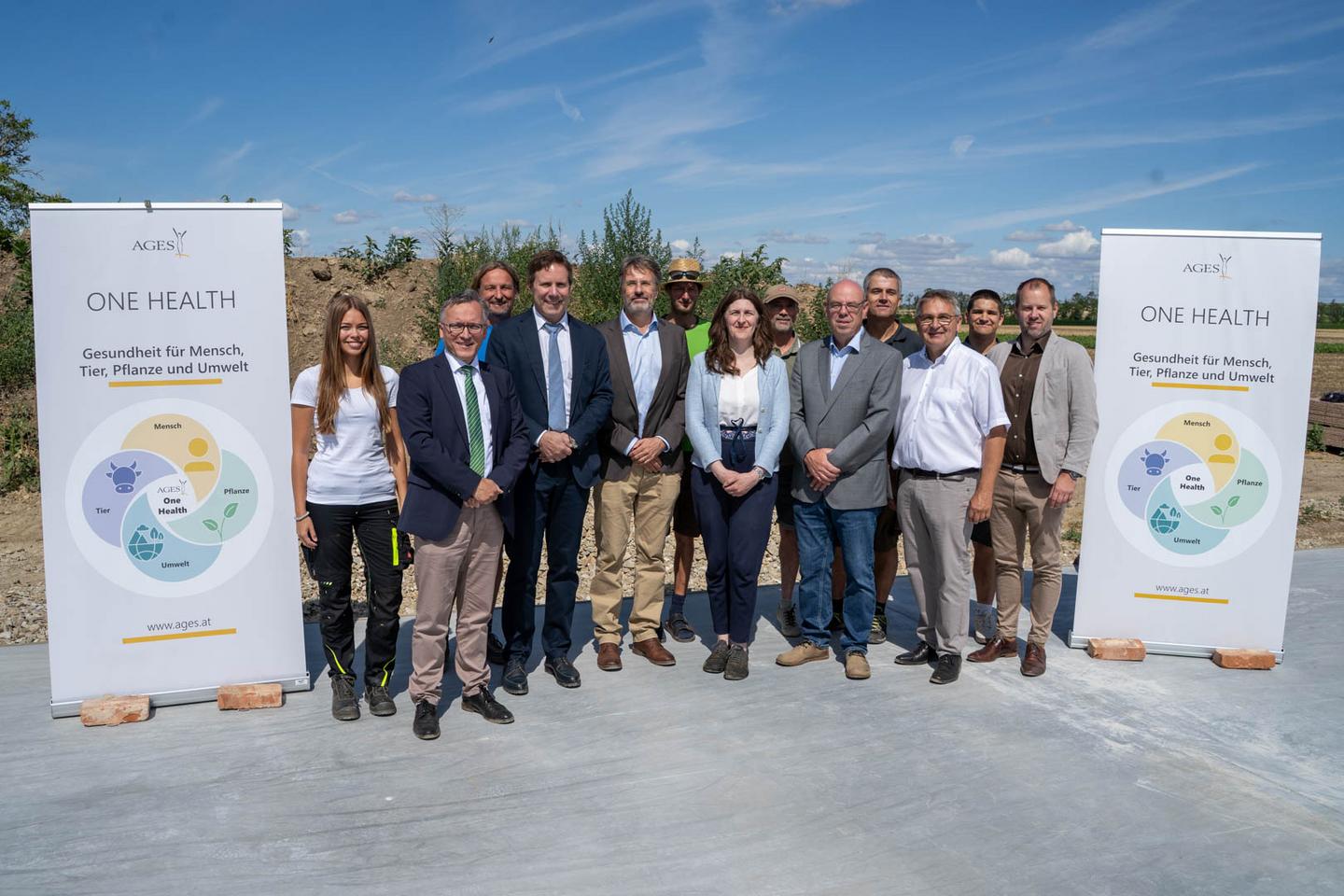
Together with Federal Minister Norbert Totschnig, Federal Ministry of Agriculture and Forestry, Climate and Environmental Protection, Regions and Water Management, AGES managing directors Johannes Pleiner-Duxneuner and Anton Reinl, and Elisabeth Jöchlinger, head of the Institute for Sustainable Crop Production, the construction project was launched today with a ground-breaking ceremony.
Großnondorf as a key location for climate-resilient agriculture
AGES operates eight agricultural research stations on behalf of the Federal Ministry of Agriculture and Forestry, Climate and Environmental Protection, Regions and Water Management (BMLUK), covering all the key climatic and soil conditions of Austria’s arable farming regions. The Großnondorf experimental station is situated in the Pannonian dry region and thus represents 250,000 hectares of arable land. The site covers arable areas with deep soils that can store rainfall for longer periods. No artificial irrigation is carried out at the Großnondorf site, making it essential for the development of climate-resilient varieties, the study of drought-induced stress and future-oriented breeding work.
Variety evaluation and variety approval in Austria ensure that new agricultural plant varieties do indeed offer added value under Austrian growing conditions. AGES’s eight agricultural research stations represent the climatic and soil conditions of Austria’s four arable ‘reference environments’: Pannonian, Illyrian-Southern Alpine, Northern Alpine and Northern Alpine-Baltic. This enables AGES experts to carry out precision field trials based on scientific principles to investigate the characteristics of plant varieties, fertilisation and plant nutrition, irrigation and soil cultivation, as well as plant protection. The trial programme thus provides reliable data for authorisation, research, risk assessment and agricultural issues relating to crops such as cereals, soya beans, maize, sunflowers, potatoes and sugar beet.
Variety testing is carried out at various locations to determine how well a variety copes with different climatic conditions and soil types in the respective arable farming region. Only varieties with a demonstrable benefit for agriculture and for Austrian consumers are approved. Austrian variety testing makes a significant contribution to the competitiveness of Austrian agriculture.
Further links: