Foodborne disease outbreaks
Consumers expect hygienically safe food and the food industry attaches great importance to the quality of its products. If people nevertheless fall ill as a result of eating food contaminated with pathogens, an attempt should be made to find out the causes.
In individual cases, it is usually not possible to find the cause of the disease in the variety of foods consumed. However, in group illnesses, known as foodborne outbreaks, there is a better chance of finding the food that served as the transmission vehicle for the pathogen by working out characteristic similarities between cases.
Definition: a foodborne outbreak is defined in the Zoonoses Act 2005 as follows: The occurrence, under given circumstances, of a disease and/or infection associated or likely to be associated with the same food or food business in at least two cases in humans, or a situation in which the cases detected are more prevalent than expected.
Situation in 2025
In 2025, a total of 33 foodborne disease outbreaks were reported, one fewer than in 2024. In total, 354 people were affected by the outbreaks, 45 per cent more than in 2024 (194 people), but significantly fewer than in 2019 (793 people) during the pre-COVID era. 110 people had to be hospitalised in connection with the outbreaks (2024: 77, 2023: 38, 2022: 57, 2021: 27, 2020: 17, 2019: 159); there were no deaths (2024: 2 deaths, 2023: 1 death, 2022: 4 deaths, 2021: 2 deaths, 2020: no deaths, 2019: one death). The average number of people per outbreak was 10.7, ranging from two to 86 people per outbreak.
The number of general outbreaks in 2025 was 16 (48 per cent) – including two international outbreaks and two outbreaks that continued from 2023 – whilst the number of household outbreaks was 17 (52 per cent).
As in previous years (2024: 10 outbreaks; 2023: 15 outbreaks), some of the outbreaks (n = 8) were associated with stays abroad.
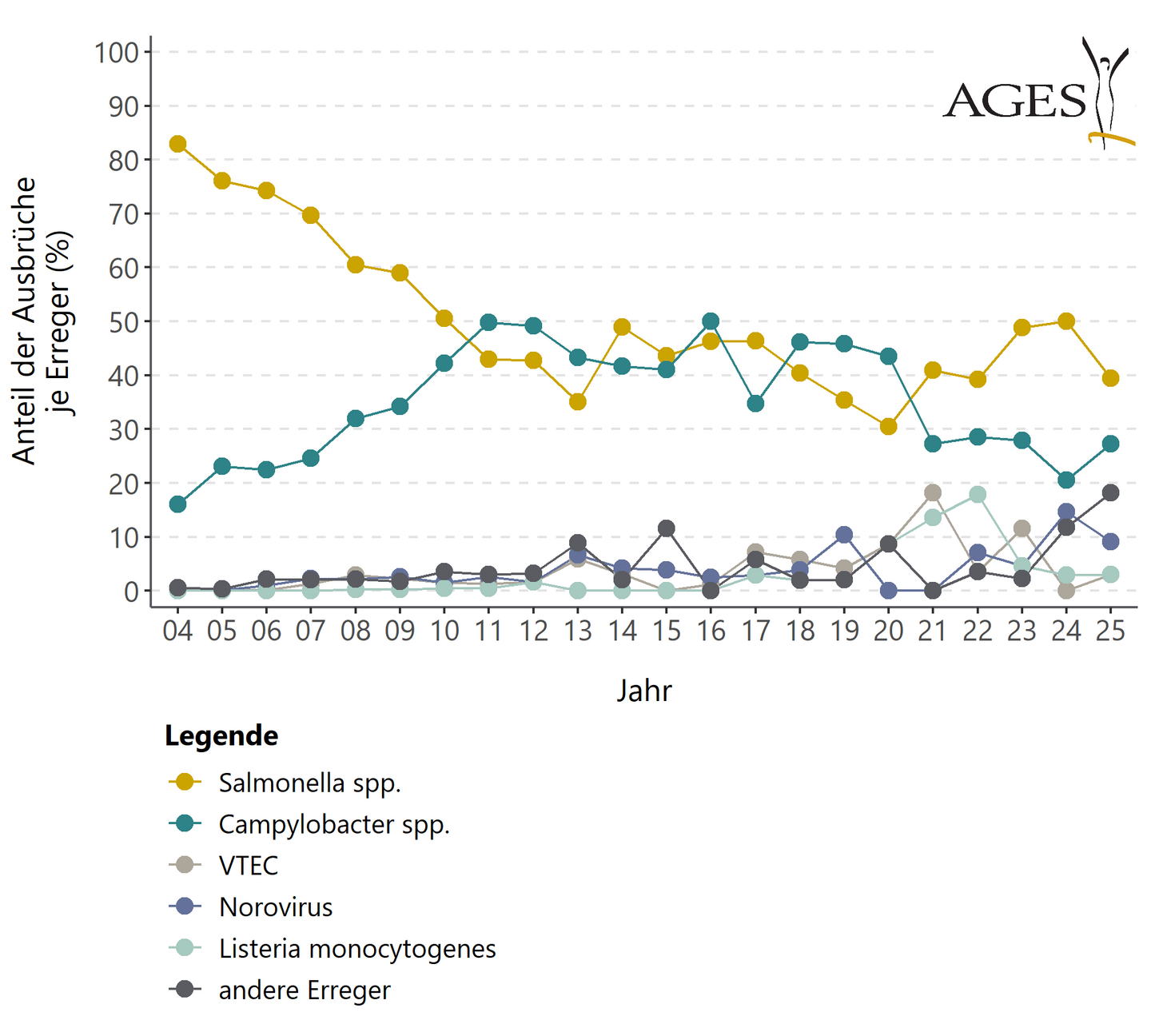
Salmonella was the most common causative agent (13 outbreaks, 278 people affected). Campylobacter was the second most common pathogen (9 outbreaks, 39 cases), followed by three outbreaks caused by norovirus (14 people) and two outbreaks caused by Shigella spp. (5 people). One outbreak each was caused by the following pathogens: non-typed E. coli (two people), STEC (two people), hepatitis A virus (three cases), Listeria monocytogenes (six people), Cereulid (3 cases) and Entamoeba histolytica (two people).
A significant, prolonged cross-border outbreak of foodborne infections was caused by the pathogen Salmonella Strathcona ST2559 CT3910. This outbreak affected 52 cases in Austria in 2025, resulting in 20 hospitalisations. Between 2023 and 30 September 2025, a total of 437 confirmed cases of S. Strathcona ST2559 were identified across 17 EU/EEA countries. Small tomatoes from Sicily were confirmed as the source of infection. In response, the Italian Food Safety Authority carried out comprehensive investigations. The detection of Salmonella Strathcona in a sample of irrigation water taken from the premises of a tomato producer in Sicily confirmed the role of the environment as a source of contamination of tomatoes. These findings also highlighted the need for a multidisciplinary approach that incorporates environmental assessments alongside food-related investigations in order to effectively reduce the risk of Salmonella contamination.
Another foodborne outbreak with strong evidence was a cross-border outbreak in Austria and Germany, caused by Salmonella Infantis ST603 CT28911. In Austria, this outbreak led to 20 cases of illness and ten hospital admissions. Investigations enabled the source of infection to be quickly identified and microbiologically confirmed: organic cashew butter with raspberries produced by a company in Germany. The company concerned subsequently withdrew the products from the market and issued several public product recalls for the product ‘dmBio Cashew Butter with Raspberries’. The recall covered all batches with a best-before date up to 28 April 2026.
Another outbreak of foodborne illness with strong evidence had already been ongoing since 2023. It was caused by Listeria monocytogenes Sg IIa/ST101/CT7699. In 2023, one person became infected after consuming contaminated food. In 2024, four people were affected by this outbreak; all had to be hospitalised, and one person died as a result of the infection. In 2025, six further cases were recorded, with all those affected also requiring hospitalisation. Meat and meat products were identified as the contaminated foodstuffs.
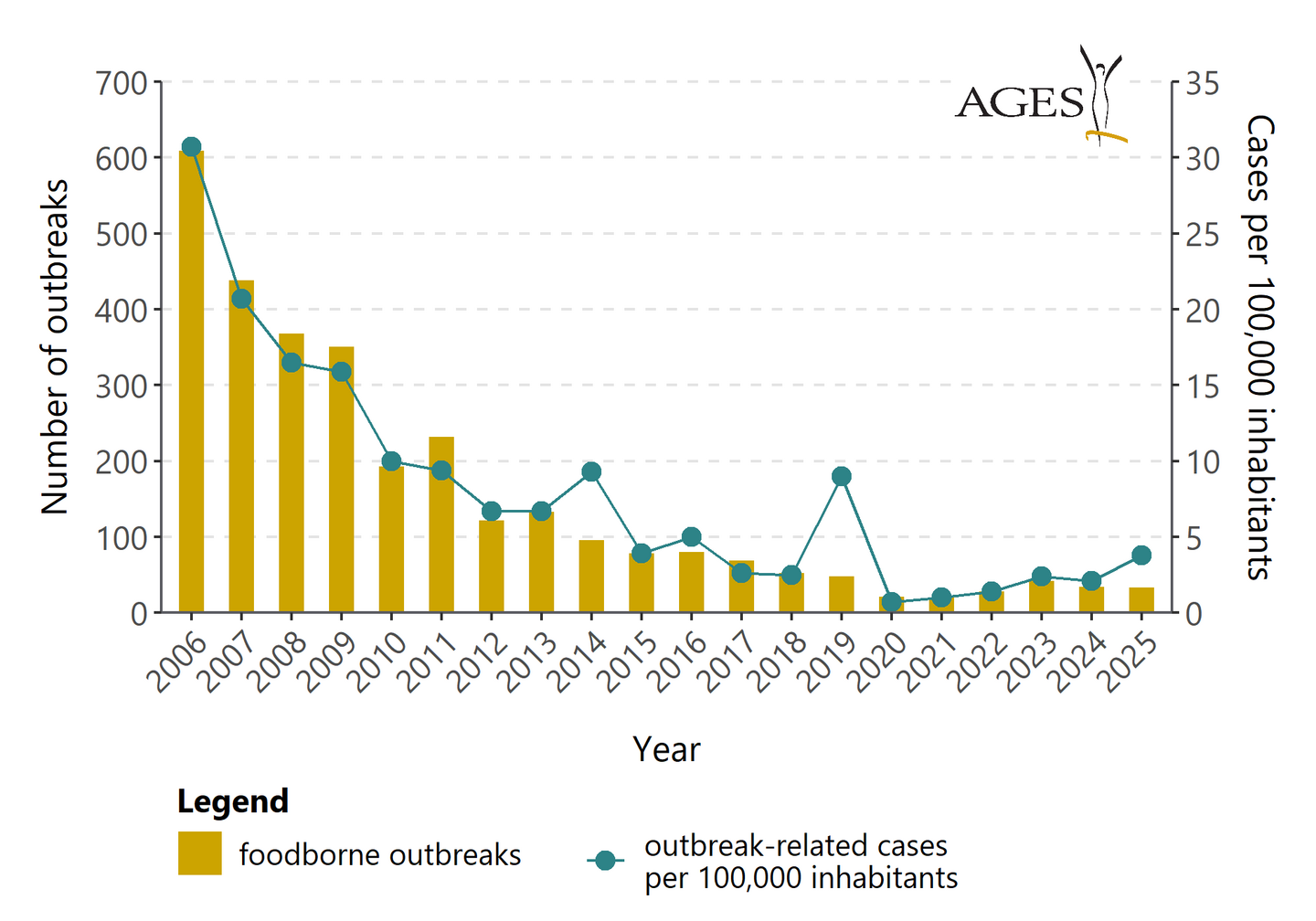
| Year | 2006 | 2007 | 2008 | 2009 | 2010 | 2011 | 2012 | 2013 | 2014 | 2015 | 2016 | 2017 | 2018 | 2019 | 2020 | 2021 | 2022 | 2023 | 2024 | 2025 |
|---|---|---|---|---|---|---|---|---|---|---|---|---|---|---|---|---|---|---|---|---|
| Foodborne outbreaks | 609 | 438 | 368 | 351 | 193 | 232 | 122 | 133 | 96 | 78 | 80 | 69 | 52 | 48 | 22 | 22 | 28 | 43 | 34 | 33 |
| - of which caused by Salmonella | 452 | 305 | 223 | 207 | 98 | 100 | 53 | 47 | 47 | 34 | 37 | 32 | 21 | 17 | 7 | 9 | 11 | 21 | 17 | 13 |
| - of which caused by Campylobacter | 137 | 108 | 118 | 120 | 82 | 116 | 61 | 58 | 40 | 32 | 40 | 24 | 24 | 22 | 10 | 6 | 8 | 12 | 7 | 9 |
| Number of cases (associated with foodborne outbreaks) | 2,530 | 1,715 | 1,376 | 1,330 | 838 | 789 | 561 | 568 | 790 | 333 | 436 | 227 | 222 | 793 | 70 | 95 | 127 | 223 | 194 | 354 |
| - Cases linked to outbreaks per 100,000 residents | 30.7 | 20.7 | 16.5 | 15.9 | 10.0 | 9.4 | 6.7 | 6.7 | 9.3 | 3.9 | 5.0 | 2.6 | 2.5 | 9.0 | 0.7 | 1.0 | 1.4 | 2.4 | 2.1 | 3.8 |
| - of whom were treated in hospital | 493 | 286 | 338 | 223 | 155 | 179 | 179 | 108 | 121 | 86 | 68 | 56 | 58 | 159 | 20 | 30 | 56 | 39 | 77 | 110 |
| - Number of deaths | 3 | 1 | 0 | 6 | 2 | 0 | 0 | 0 | 1 | 0 | 0 | 2 | 0 | 1 | 1 | 4 | 3 | 1 | 2 | 0 |
Types of outbreaks
Based on the Austrian Zoonoses Act, we collect the outbreak data annually and forward it to the EU. Certain classifications are used for this reporting: Outbreaks in which only members of a single household are affected are categorised as household outbreaks. If people from several households are affected, this is counted as a general outbreak. Household outbreaks account for the majority (approx. 75 %) each year because it is often not possible to epidemiologically link cases of illness from different household outbreaks by identifying a single causative foodstuff.
Outbreak investigation
The aim of outbreak investigation is not only to stop the current outbreak, but above all to prevent such diseases in general in the future.
Through a detailed and systematic investigation, it is possible to identify both the vehicle of infection – that is, the foodstuff that transmitted the infectious agent to humans – and the reservoir, which constitutes the habitat of an infectious agent. Only then is it possible to implement targeted and effective interventions. These measures should result in the cause of the outbreak – namely, the infectious agent – being eliminated from the food chain, ensuring that consumers are no longer exposed to this agent.
The potential of outbreak investigation in preventive medicine is clearly illustrated by the following historical example: In July 2004, investigators succeeded in identifying the source of a foodborne outbreak caused by Salmonella Enteritidis phage type 36 – a type of Salmonella that is very rare in Austria – which affected 38 people across four federal states, and traced it back to a flock of laying hens. The flock was culled, the farm thoroughly cleaned and disinfected; new laying hens were then introduced. As a result of these measures, not a single further case of illness caused by Salmonella Enteritidis phage type 36 has been reported in Austria since then.
Since 2009, bacterial and viral foodborne infections and food poisoning have been reported via the EMS, a nationwide surveillance system. However, these reported figures must be viewed in a nuanced manner: Numerous factors can lead to an underestimation of the actual number of cases (‘underdetection/underreporting’). The quality of the data often varies depending on the pathogen: for salmonella, for example, data are available from Europe-wide baseline studies, surveillance and control programmes. The decline in salmonellosis cases is a result of measures implemented on the basis of this data. Toxoplasmosis, on the other hand, is not a notifiable disease, although new scientific findings suggest a link to food. All these factors must be taken into account when assessing the actual significance of a disease for public health.
Implementation
In accordance with the provisions of the Epidemics Act, the locally competent district administrative authorities must, through the public health officers at their disposal, act on every report and on every suspected case of a notifiable disease – and thus also in the event of foodborne disease outbreaks – to immediately initiate the investigations and examinations necessary to identify the disease and the source of infection. Furthermore, the Zoonoses Act 2005 obliges the relevant competent authorities to investigate foodborne disease outbreaks and, as far as possible, to carry out appropriate epidemiological and microbiological investigations.
The authorities have the option of consulting experts in this regard. Merely stepping up untargeted food sampling has repeatedly proved ineffective in the past. In many outbreaks, the food responsible (or the affected contaminated batch of the product in question) is no longer available for microbiological testing by the time the investigations take place.
In such cases, an epidemiological study can provide insights that enable preventive measures to be taken to avoid similar incidents in the future. The lessons learnt from successfully investigated national and international outbreaks in recent years have left no doubt as to the necessity and benefits of epidemiological investigations.
Research project ‘Data Flow Mapping in a Member State’
In the ‘Data Flow Mapping in a Member State’ project, which focused on foodborne disease outbreaks, the aim was to document the individual process steps in the data flow. The topics covered the individual stakeholders in the data flow – from data entry into the EMS through data cleansing and mapping to data transfer to the EFSA. Furthermore, information on the data format and the programmes or data models used in the individual process steps was collected.
For those steps where time-consuming investigations and adjustments were most frequently identified, targeted solutions are to be developed in future to reduce both the additional staff workload involved in data preparation and the risk of errors.
Further details on the research project, which is financially supported by EFSA, can be found in the report for Austria https://www.efsa.europa.eu/en/supporting/pub/en-9652 and the pan-European report https://www.efsa.europa.eu/en/supporting/pub/en-9654.
Last updated: 13.10.2026
automatically translated