Development and authorisation of vaccines
Like all medicines, vaccines are developed, tested and authorised in accordance with current regulatory guidelines and legal requirements, and in line with scientific guidelines. The aim is to provide a high-quality, effective and, above all, safe vaccine.
The time taken from the initial idea to an approved vaccine depends on many variables. Does it involve a known or new manufacturing technology (‘platform’); is it a well-established vaccine (e.g. against whooping cough) or an innovation; is it a combination vaccine with different active ingredients (antigens); or does it involve a known or novel administration technique? In addition to highly specialised expertise for these complex medicines, which are classified as ‘biologics’, enormous financial resources and considerable perseverance are also required, as only a fraction of all substances tested make it to market.
And even if the full development programme outlined here has been successfully completed up to the point of approval, the major challenge of regulatory approval still remains. Once this has been achieved, production takes place on a ‘large scale’ for the market.
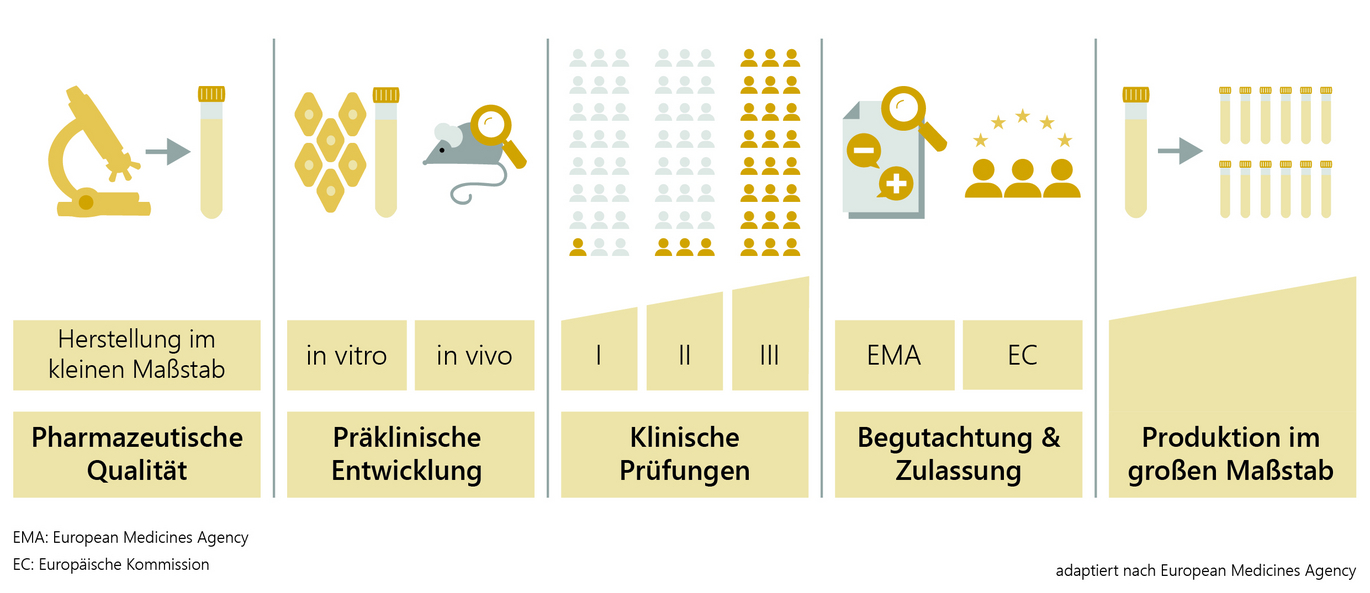
Vaccine development
The identification and research of a vaccine candidate in the laboratory takes around two to five years. First, the pathogen (virus or bacterium) is analysed to determine which components are best suited to enable the human immune system to respond and build up sufficient protection (e.g. antibodies). This is followed by the development of the vaccine and small-scale production for further testing in animals (preclinical) and humans (clinical).
In preclinical vaccine development, the immunogenicity (the antigen’s ability to trigger an immune response), efficacy and safety of the vaccine are tested in cell cultures (in vitro, e.g. using human immune cells) and in animal trials (in vivo). This also takes around two to five years.
Only after extensive investigations and confirmation that the vaccine can be manufactured to a high standard and in compliance with all stringent requirements is the vaccine tested in clinical trials on volunteers who have been fully informed of all potential risks:
Clinical trials
The relevant national authorities and ethics committees ensure that all trials are scientifically sound and conducted in an ethically correct manner. Clinical trials conducted prior to vaccine authorisation can be divided into three phases.
Phase I: Typically, between 20 and 100 healthy volunteers take part to determine, through laboratory tests, whether the vaccine triggers the expected immune response (immunogenicity). However, the primary focus here is on testing safety and tolerability.
Phase II: Studies involving several hundred volunteers provide information on the best possible vaccine dosage for optimal protection, the side-effect profile, and the number of doses required for the best possible vaccination schedule.
Phase III: In the final phase, the vaccine is tested on several thousand (in the case of the first COVID-19 vaccines, several tens of thousands) volunteers in the target population. Here, it must be demonstrated how effectively the vaccine protects against the disease compared to a control group (e.g. placebo) and which side effects may occur, and with what frequency.
The authorisation
An official authorisation procedure is, in principle, a prerequisite for a vaccine to be placed on the market. Authorisation involves assessing a vaccine for quality, efficacy and safety on the basis of the data submitted by the applicant.
The applicant and the law determine whether a vaccine can be submitted for authorisation in just one country (national), in several European countries, or across the entire EEA (EU countries plus Norway, Iceland and Liechtenstein) under the so-called ‘centralised procedure’.
The applicant submits marketing authorisation documents for regulatory review in accordance with clearly defined guidelines. These include, amongst other things, regulatory information, manufacturing data, preclinical and clinical data, current scientific literature, and information on the planned long-term post-marketing surveillance following authorisation. In addition to the vaccine antigen, the “actual active ingredient”, all other components of a vaccine are also evaluated. The European Pharmacopoeia, which has the force of law, defines these components, including their permissible limits. Furthermore, a myriad of statutory laws and regulatory-scientific frameworks must be observed.
Following an assessment of all this data and the studies collected and conducted as part of the development programme, medicines regulatory authorities carry out the final evaluation of the resulting risk-benefit profile.
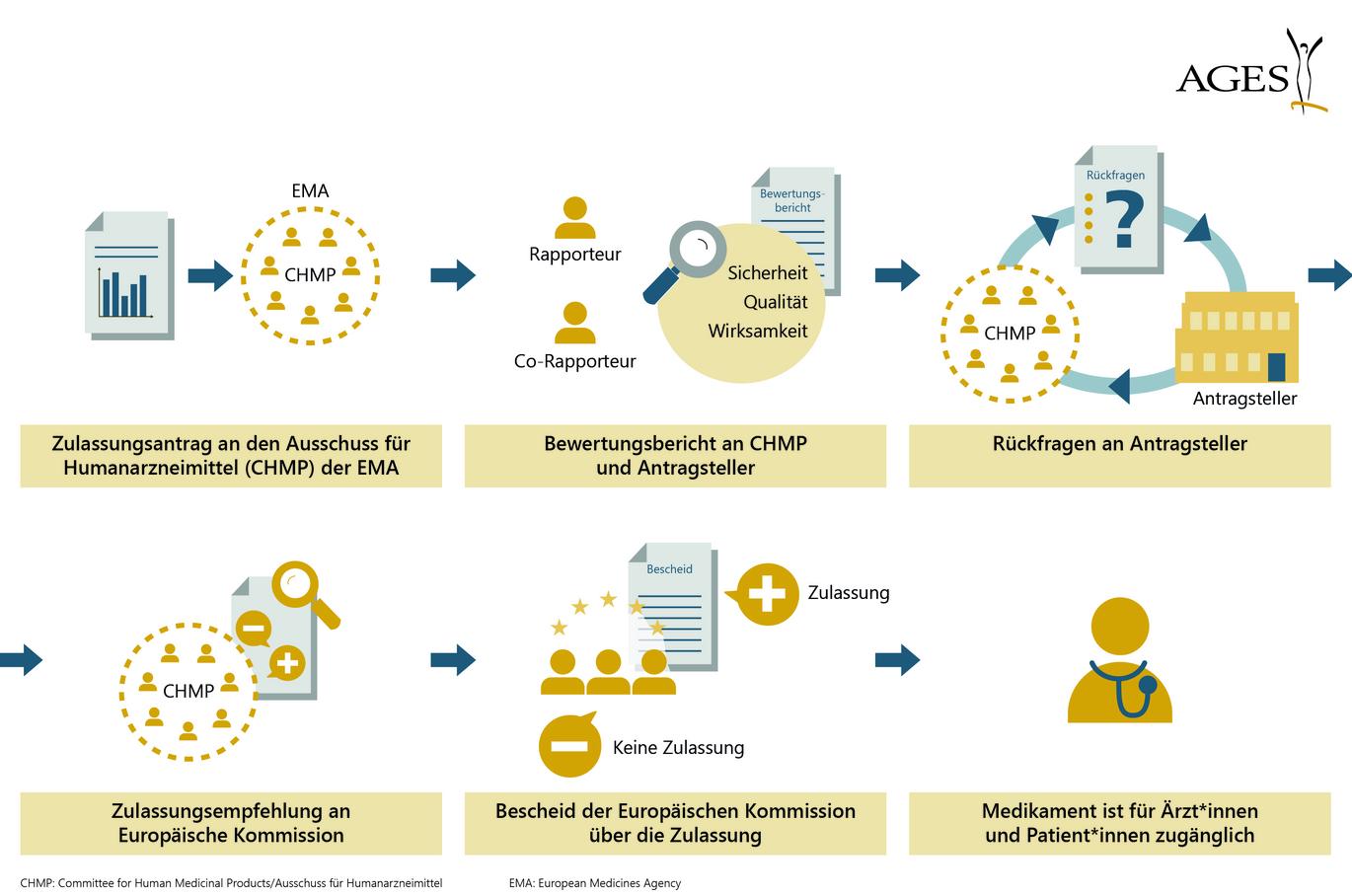
In the EU, the so-called ‘centralised authorisation procedure’ for many vaccines, including all COVID-19 vaccines, is coordinated by the European Medicines Agency (EMA) in Amsterdam. The national medicines regulatory authorities of the EU, as well as those of Norway, Iceland and Liechtenstein, are involved in the technical assessment.
If the vaccine meets all scientific and regulatory requirements and its benefits outweigh any risks, following a successful authorisation procedure, the CHMP – the EMA’s expert committee (comprising experts from EEA member states, patient representatives, etc.), a recommendation for authorisation of the vaccine is submitted to the European Commission, which grants the authorisation. National authorisation is no longer required. An authorisation procedure can take up to two years.
In addition, in Austria, batch release by an officially designated medicines control laboratory (OMCL – Official Medicines Control Laboratory of AGES) is required before the vaccine can be placed on the market. A batch is a quantity of vaccine produced as part of a single manufacturing process. Any medicines control laboratory in the EU or the European Economic Area (EEA) and in Switzerland may, provided it meets the legal requirements, carry out batch release for vaccines. The release certificates must then be recognised throughout the EU, the EEA and Switzerland. Manufacturers are free to choose which medicines control laboratory they submit their vaccine to for batch release.
COVID-19 vaccines
Given the severe consequences of the pandemic and the lack of available, approved COVID-19 vaccines, the development and regulatory approval process for these vaccines was initially fast-tracked. This process drew on extensive existing knowledge of coronaviruses and vaccine development.
To speed up development, companies and research institutions deployed significantly more staff and financial resources in a shorter timeframe than is typical for conventional development processes. Where possible, whilst complying with strict safety requirements, trial phases were conducted in parallel rather than sequentially as is usually the case. Furthermore, manufacturers expanded their production facilities at a much earlier stage of vaccine development than usual, so that large quantities of vaccine could be made available very quickly once authorised.
During this period, the EMA and European medicines agencies also pooled all their resources to rapidly make a high-quality, effective and safe vaccine available to the European population, which they succeeded in doing. These vaccines have made an immense contribution to preventing serious complications, hospitalisations and deaths.
Approvals for COVID-19 vaccines have long since ceased to be fast-tracked, as there are now sufficient authorised vaccines available. They are approved in exactly the same way as any other standard vaccine.
Pharmacovigilance
Vaccines are continuously monitored not only before and during the approval process, but also whilst they are on the market. Pharmacovigilance refers to a wide range of methods and activities designed, amongst other things, to detect, assess, understand and prevent adverse reactions.
Part of pharmacovigilance is the obligation for healthcare professionals to report incidents relating to the use of vaccines. For human medicines, this applies to suspected adverse reactions and also to the absence of the expected efficacy. However, it is not only healthcare professionals but also patients and their relatives who can report suspected adverse reactions. Reports must be submitted electronically or in writing to the Federal Office for Safety in Healthcare (BASG).
All reports of suspected adverse reactions are collected across the EU. The analysis of all this data makes it possible to identify a potential new risk at national and European level (signal detection), to examine it closely and thus to contribute to greater medicinal product safety for all patients. If a signal is detected, it is assessed in the European context by the EMA’s Pharmacovigilance Risk Assessment Committee (PRAC). Depending on the outcome of the assessment, measures such as the inclusion of new warnings in the summary of product characteristics or, in extreme cases, even the withdrawal of a vaccine’s marketing authorisation are taken.
As a further safety measure, a mandatory batch test by an OMCL is still carried out for every new batch. Only after certified batch release can a vaccine be made available to healthcare professionals and ultimately to the vaccine recipient.
Vaccine information
Further information on medicines, vaccines and medical devices, as well as on authorisation, can be found on the websites of the Federal Office for Safety in Healthcare (BASG), the Federal Ministry of Labour, Social Affairs, Health, Care and Consumer Protection (BMASGPK) and the European Medicines Agency (EMA):
Last updated: 27.05.2026
automatically translated