Radioactivity in wood fuels and their residues
Wood residues can accumulate harmful substances such as heavy metals and radioactive materials, although the quantities can vary considerably. The highest concentrations of radioactive materials are found in wood pellet ash and wood briquette ash. For this reason, amongst others, wood pellet ash and wood briquette ash should not be used as garden fertiliser without prior testing.
Wood is a relatively fast-growing renewable resource and is considered an environmentally friendly, largely carbon-neutral fuel. The combustion process produces only ash as a waste product. The gasification process produces both ash and biochar. For each type of wood fuel (wood pellets, wood chips, logs and wood briquettes), there are specially designed biomass systems that are optimally adapted to the product used.
Heating with wood pellets is subsidised by the federal government, the federal states and local authorities. In recent years, an increasing number of private households have been heating their homes with pellet boilers. Nationwide, there are more pellet boilers in households than other types of biomass boilers. Commercial biomass heating plants and biomass CHP plants (CHP stands for combined heat and power) in Austria are currently operated primarily using wood chips, sawmill by-products and bark. During the heating process, the organic component of the wood is burned, whilst the mineral, non-combustible portion remains as ash.
Radioactivity in the environment
Radioactivity is present everywhere in nature. Natural radionuclides have either existed since the formation of our solar system (primordial radionuclides) or are continuously produced by the interaction of high-energy cosmic radiation with the Earth’s atmosphere (cosmogenic radionuclides). Radioactive substances that do not occur naturally but are produced by humans are called artificial radionuclides.
Radionuclides in wood residues
The soil contains, amongst others, the natural radionuclides potassium-40, radium-226 and thorium-232. Potassium-40 and thorium-232 are primordial radionuclides which, due to their long half-lives, are still present today. Radium-226 is produced in the decay chain of the primordial radionuclide uranium-238.
Partly as a result of the Chernobyl reactor accident (1986), artificial radionuclides such as caesium-137 and strontium-90 were dispersed across several European countries, including Austria. Due to their half-life of approximately 30 years, they can still be detected in the environment in the affected areas.
Plants such as trees absorb these radioactive substances through the soil, which can lead to an accumulation of these natural and artificial radionuclides in the wood residues (e.g. ash, biochar) during the combustion or gasification process.
The radioactivity in the wood itself is harmless from a radiation protection perspective and therefore poses no health risk to the population. However, the accumulation of radioactive substances in the resulting wood residues (e.g. ash, biochar) varies greatly and may be relevant from a radiation protection perspective.
AGES monitoring project on the monitoring of radioactivity in wood fuels
As early as 1998, the Austrian Federal Environment Agency, in collaboration with the Federal Institute for Food Analysis (now AGES), reported on the caesium content in Austrian wood ash (report). As there was little up-to-date data available for Austria, we carried out a project on behalf of the former Ministry for Climate Protection in 2020/21 to monitor the radioactivity of wood fuels and wood ash (in accordance with Section 125 of the Radiation Protection Act 2020). The ash samples were sourced from private households. The main focus was on wood pellet samples, as their ash content is the lowest compared to that of other wood fuels. Consequently, the accumulation of radioactive substances in wood pellet ash is higher.
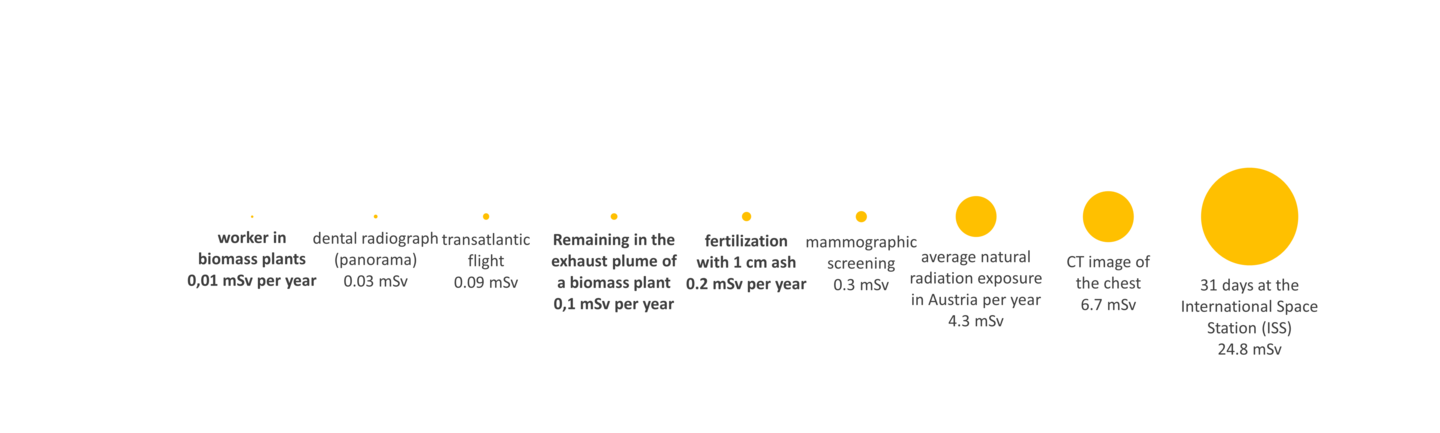
Based on our project results, an estimate was made of the radiation exposure (= dose) to individual members of the public from the artificial radionuclides caesium-137 and strontium-90 when using wood pellet ash to fertilise vegetables in the garden. It was assumed that fertilisation is carried out annually with a one-centimetre-thick layer of ash and that half of the vegetables consumed each year come from the individual’s own garden. The highest measured radioactivity levels were used for the calculation. In this case, the annual dose for an individual in the general population is 0.2 millisieverts (abbreviation: mSv).
AGES project on monitoring radioactivity in industrial wood waste
The increasing use of biomass for energy generation results in the production of large quantities of biomass residues (several hundred thousand tonnes annually) and thus presents new challenges as well as opportunities for sustainable utilisation. We therefore carried out a project on behalf of the formerly the Ministry for Climate Protection in 2023/24 to monitor radioactivity in wood residues from commercial biomass heating plants and biomass CHP plants (in accordance with Section 125 of the Radiation Protection Act 2020). The aim of this project was to investigate whether people working with these residues or living near such facilities might be exposed to an increased dose.
Based on our project results, an assessment of the dose from the natural radionuclides potassium-40, radium-226 and thorium-232, as well as the artificial radionuclides caesium-137 and strontium-90, was carried out for both workers and members of the general public. For workers in biomass plants, an annual dose of 0.01 mSv was calculated for a realistic annual exposure time of 62.5 hours at the location of highest dose rate. For members of the public in the exhaust plume of biomass cogeneration plants or CHP plants with a stack height of 0–5 metres at a horizontal distance of 100 metres from the stack, an annual dose of less than 0.1 mSv was calculated.
As the following graph shows, the estimated radiation exposure levels are very low compared to other sources of radiation exposure.
The dose assessments carried out for workers and affected members of the public have shown that no measures are required from a radiation protection perspective.
Nevertheless, we do not recommend spreading wood pellet ash or wood briquette ash in the garden or even on a vegetable patch without first testing it. This is because, in addition to radioactive substances, the ash may also contain concentrations of non-combustible and potentially harmful minerals, salts, heavy metals and organic pollutants.
The disposal of ash in private households is regulated differently in each federal state and often also in each municipality. In most parts of Austria, it is mandatory to dispose of cooled ash in general waste.
In principle, a circular economy should be aimed for in relation to commercially produced wood residues (e.g. ash, biochar). Wood ash can, for example, be used as an aggregate in the production of building materials or for composting (see ‘Guidelines for the proper use of plant ash’ at the bottom of this page under Downloads). If wood ash is reused as an aggregate, the impact of both natural and artificial radionuclides must be assessed. In accordance with Section 123(1) of the AllgStrSchV 2020, the reference value for external exposure in occupied rooms due to gamma radiation from construction products is 1 mSv effective dose per year.
Whilst no measures are required for the general public from a radiation protection perspective, relevant exposures may occur for workers during certain occupational activities. We would like to draw attention to the fact that, in accordance with Section 23 of the StrSchG 2020, a dose assessment must be arranged for workers in the following activities, amongst others: Activities involving exposure from residues, such as maintenance work, in particular the maintenance and removal of heat-resistant cladding made of zirconium-containing material, cleaning or modification and dismantling of pipework and technical installations such as pumps and valves, maintenance as well as modification and dismantling of filter systems and flue gas scrubbers.
Detailed technical information on the project can be found in the two final reports, which are available under Downloads.
Contact us
Mag. Dr. Claudia Landstetter
- strahlenschutz.wien@ages.at
- +43 664 8398143
-
Spargelfeldstraße 191
1220 Wien
Last updated: 22.06.2026
automatically translated