Animal feed
Sampling is carried out on a random basis, and approximately 50 feed samples from different feed categories are analysed each year. Between 2017 and 2025, a total of 506 feed samples were analysed. These included single-ingredient feedstuffs (such as cereal grains), premixes, additives (such as minerals and vitamins) and compound feed (consisting of several single-ingredient feedstuffs and additives). Compound feed includes, on the one hand, complete feed, which is suitable for fully meeting the nutritional requirements of a specific animal species (for example, poultry or pigs), and, on the other hand, supplementary feed, which accounts for only a small proportion of the total feed consumed.
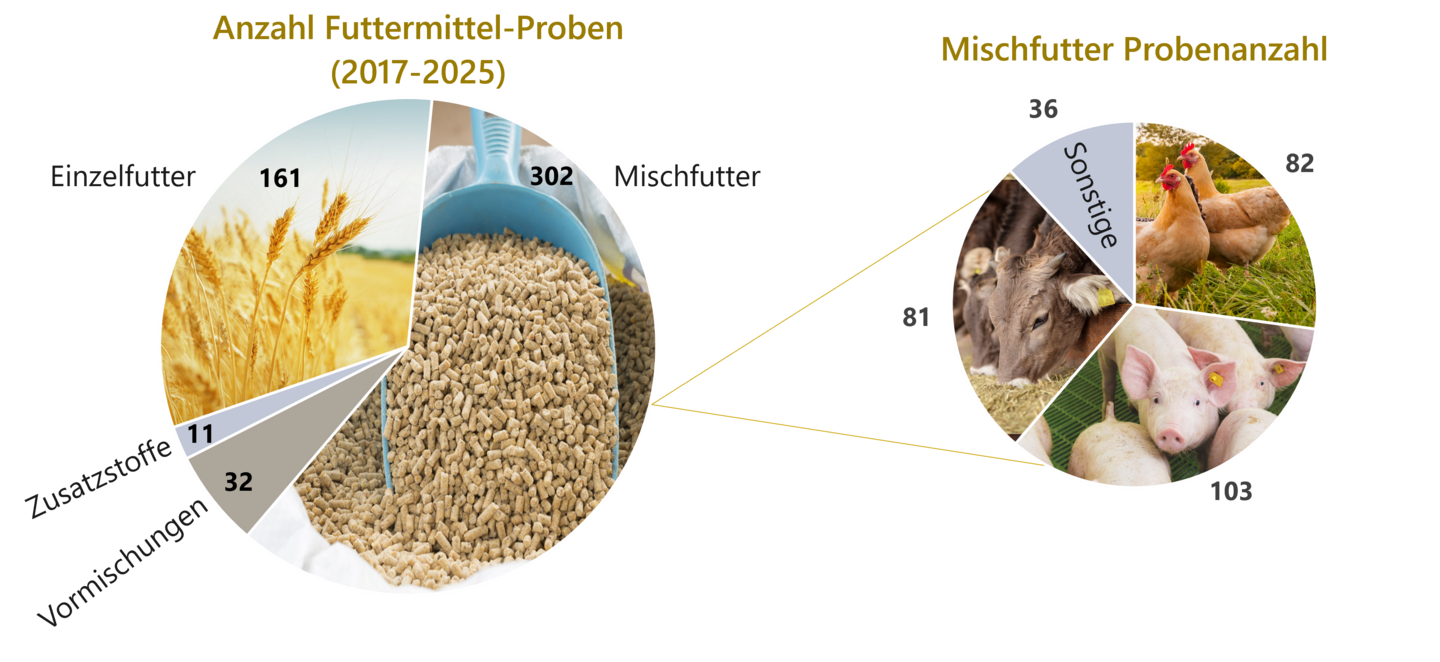
In the analysis of animal feed, the radionuclides caesium-137, radium-226 and thorium-232 are of particular significance.
Caesium-137 was detected in 9 per cent of the samples. Most of these samples were of organic origin, and the caesium-137 probably originated from the radioactive fallout following the Chernobyl disaster. The activity concentrations of caesium-137 ranged from 0.2 to 12.46 Bq/kg.
Radium-226 is a naturally occurring radionuclide formed in the decay chain of uranium-238 and found in uranium-bearing minerals. Radium-226 was detected in approximately 41 per cent of the samples. Activity concentrations ranged from 0.4 to 97 Bq/kg. The highest values were found in mineral feedstuffs, premixes and additives.
Thorium-232 is a naturally occurring radionuclide found in minerals such as monazite and thorite. Thorium-232 was detected in around 25 per cent of the samples, with activity concentrations ranging from 0.3 to 97 Bq/kg. As with radium-226, the highest levels were measured in mineral feed, premixes and feed additives.
In 2025, the focus of the measurements was on cattle feed. Hay, as well as mineral and supplementary feeds, were examined in particular. The highest value for radium-226, at 6.2 Bq/kg, was measured in a mineral compound feed. For thorium-232, the highest value, 16.2 Bq/kg, was found in a hay sample. The artificial radionuclide caesium-137 was detected in 13 of the 25 hay samples analysed, with a maximum value of 12 Bq/kg. None of the measured values are of concern from a health perspective.
Fertiliser
Fertilisers are used to supplement the supply of nutrients for crops. In addition to heat, light, air and water, plants also require nutrients for their growth. These nutrients are often not present in the soil in the optimal form or quantity for utilisation. On the one hand, they are leached out of the soil or removed from it in considerable quantities by the crops being grown. The supply of plant nutrients through fertilisation makes it possible to replace the nutrients that have been lost. Further general information on fertilisers can also be found here.
The radionuclides contained in fertilisers can be taken up by the cultivated plants and thus enter the food chain. We therefore regularly analyse fertilisers as part of our laboratory-based environmental monitoring programme. This involves analysing different types of fertiliser (mineral and organic), as well as growing media (soils) and plant additives (such as rock dust). Mineral fertilisers contain nutrients in the form of salts that can be taken up directly by plants (for example, nitrogen, phosphorus and potassium). Organic fertilisers consist of natural raw materials such as compost, farmyard manure or slurry. The nutrients they contain are converted in the soil by microorganisms.
We analyse around 50 fertiliser samples each year. Between 2016 and 2025, a total of 466 samples were analysed. The radionuclides analysed include both natural radionuclides such as potassium-40, radium-226 and thorium-232, as well as the artificial radionuclide caesium-137.
In 2025, the highest levels of radium-226, at 533 Bq/kg, were measured in a concentrated phosphorus fertiliser (triple superphosphate). The highest level of potassium-40, at 15,390 Bq/kg, was found in a mineral potassium chloride fertiliser. The highest level of thorium-232 was detected at 78 Bg/kg in rock dust (a soil amendment). Caesium-137 was found only in two samples, in extremely small quantities.
In Austria, approximately 100 kg of fertiliser (mineral fertiliser) is applied annually per hectare of conventionally farmed land requiring fertilisation. If only the fertilisers with the highest measured concentrations were applied, this would result in the following activity levels per square metre: 5.5 Bq/m² for radium-226, 154 Bq/m² for potassium-40, 0.8 Bq/m² for thorium-232.
The radioactivity applied is negligible and poses no health risk.
Further in-depth studies in 2025
As part of an extended screening programme, a further 35 fertiliser samples from various product groups were tested for radioactivity in 2025. The analysis covered organic and mineral fertilisers as well as selected soil amendments. In addition to determining natural and artificial radionuclides using gamma spectrometry, selected samples were also tested for the radionuclides polonium-210 and strontium-90. These supplementary analyses served to provide a more in-depth radiological assessment of individual fertiliser groups.
The fertilisers examined included phosphate fertilisers, potash fertilisers, complete fertilisers (NPK), two-component fertilisers such as phosphorus-potassium fertilisers (PK) and nitrogen-phosphorus fertilisers (NP), organic fertilisers, soil conditioners and other individual products such as lime or sulphur fertilisers.
The investigations show that the radioactivity of fertilisers depends primarily on their raw materials and that there are therefore significant differences between the individual fertiliser groups:
- Potassium fertilisers exhibited the highest activity concentrations of naturally occurring potassium-40. The highest measured values were around 16,000 Bq/kg. Other natural radionuclides were present only in small quantities.
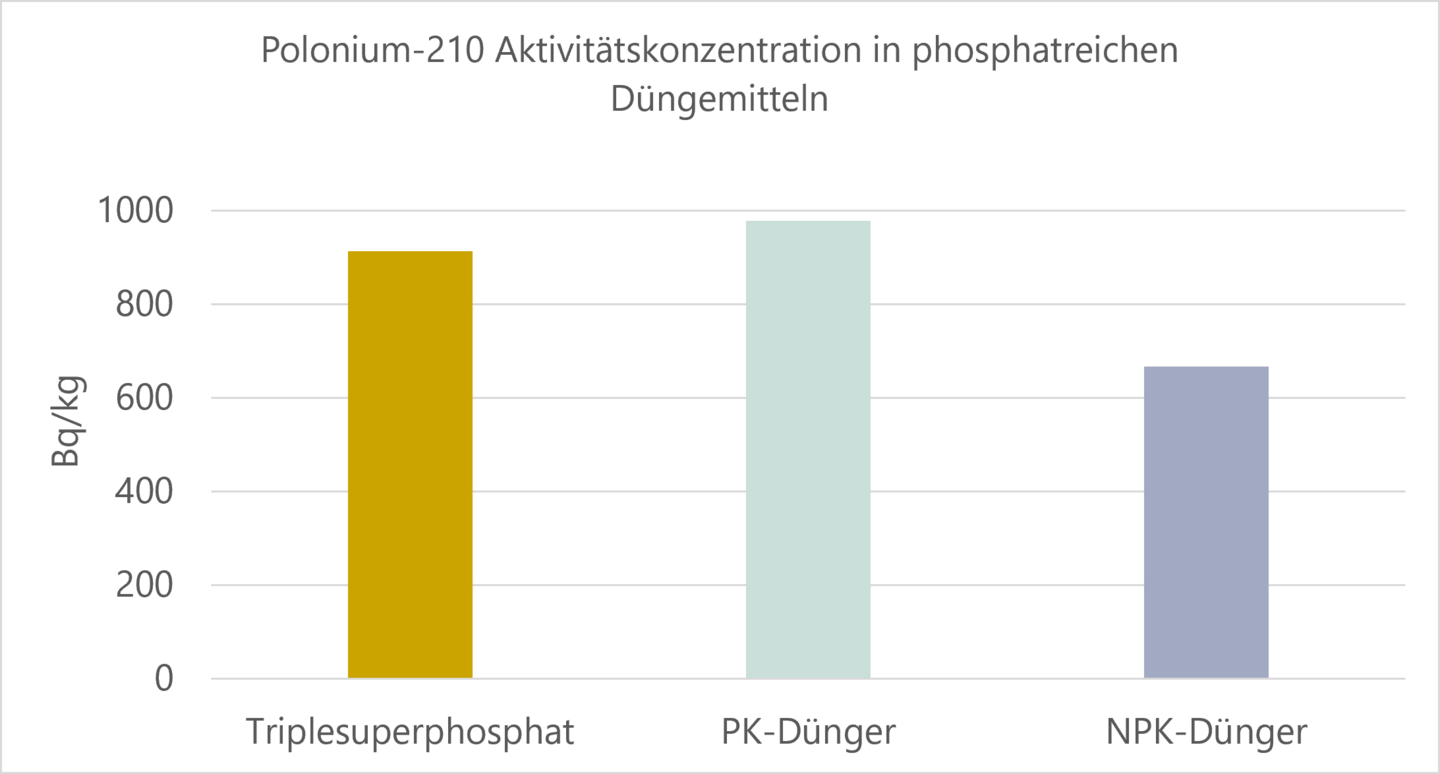
- Pure phosphate fertilisers and PK fertilisers showed the highest activity levels of natural radionuclides from the uranium-radium decay series. The highest measured values were around 2,900 Bq/kg of uranium-238, 810 Bq/kg of radium-226, 870 Bq/kg of lead-210 and 915 Bq/kg of polonium-210 for a sample of a phosphate-rich mineral fertiliser (triple superphosphate), as well as 2,800 Bq/kg of uranium-238, 830 Bq/kg of radium-226, 960 Bq/kg of lead-210 and 980 Bq/kg of polonium-210 for a PK fertiliser.
- Complete fertilisers and NP fertilisers showed varying activity concentrations depending on their composition. The highest values measured were around 730 Bq/kg of uranium-238, 665 Bq/kg of radium-226, 570 Bq/kg of lead-210 and 670 Bq/kg of polonium-210. Higher values were found primarily in phosphate-rich products.
- Organic fertilisers predominantly exhibited low activity concentrations. Potassium-40 usually made the largest contribution to the total activity. The highest value measured was around 5,200 Bq/kg of potassium-40.
- Soil additives exhibited varying levels of natural radioactivity depending on the raw material. The highest values were observed in a mica product, particularly for potassium-40 at 2,700 Bq/kg.
For selected phosphate-rich fertilisers, the natural radionuclide polonium-210 was also analysed. The figure below shows the measured activity concentrations of the samples analysed.
Artificial radionuclides were detected only in isolated cases. Traces of caesium-137 were found in two plant-charcoal-based organic fertilisers. The measured activities amounted to a maximum of 6 Bq/kg and were thus well below the activity limit of 500 Bq/kg specified in the Fertiliser Ordinance for the sum of caesium-134 and caesium-137. Caesium-134 was not detected in any of the samples analysed. Due to the detection of caesium-137, strontium-90 was also analysed in the same samples and detected at a maximum of 8 Bq/kg. The measured values for caesium-137 and strontium-90 are shown in the figure below.
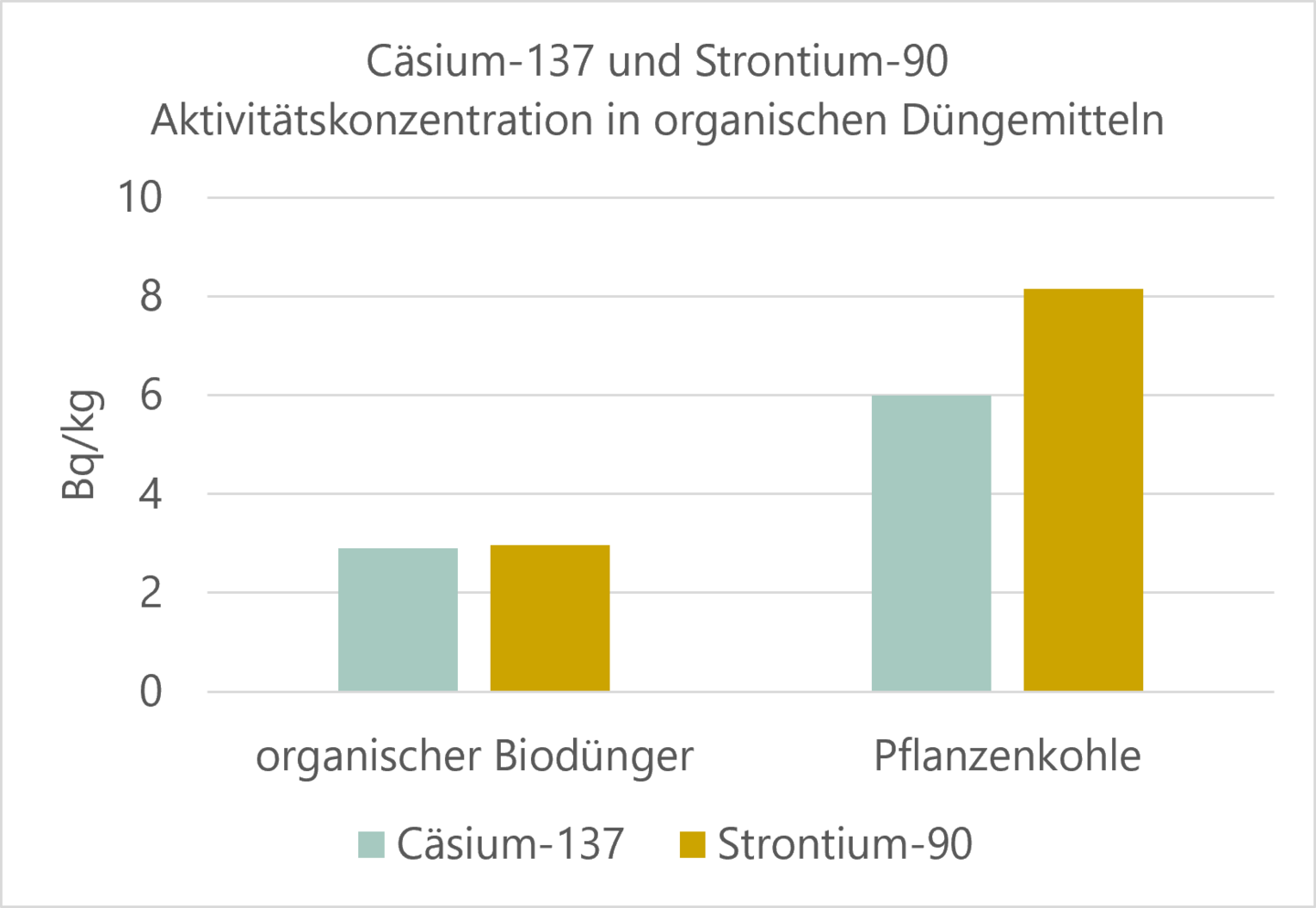
The levels of radioactivity detected are low and do not suggest any significant additional release of artificial radionuclides into the food chain. Based on current knowledge, the measured levels are of no health concern.
The screening confirms that the fertiliser groups examined differ significantly in terms of their natural radioactivity. Phosphate-based fertilisers in particular exhibit higher levels of natural radionuclides, whilst in potash fertilisers it is primarily naturally occurring potassium-40 that determines the measurement results. Artificial radioactivity was detected only in small quantities in a few organic fertilisers based on biochar.
The results provide an important basis for the ongoing monitoring of fertilisers and help to further improve the radiological assessment of these products.
Last updated: 14.10.2026
automatically translated