Radioactivity in products and goods
Radioactive substances may be present in many products and goods. In some products, radioactive substances are intentionally added to improve their properties. Under radiation protection legislation, these products are referred to as ‘consumer products’. They must be approved by the authorities in advance and are then considered safe for health from a radiological perspective.
In contrast to consumer products, “contaminated goods” contain radioactive substances that have not been intentionally added and have not been authorised by the authorities. The radioactivity present is often attributable to processed raw materials that naturally have an elevated radioactivity level. However, they may also contain artificial radioactive substances. The radioactivity levels of these raw materials can vary significantly. Such contaminated goods may not be placed on the market in Austria.
Consumer products
Consumer products are devices or items to which radioactive substances are intentionally added in order to improve their performance characteristics. Examples include high-pressure lamps used as xenon car headlights and high-power lighting used outdoors, for example in sports stadiums, which may contain small amounts of radioactive thorium-232 or tritium. Thorium is also added to electrodes used in the welding industry to improve performance and increase the electrodes’ service life.
Examples of other consumer products (Figure 1) include:
- Ionisation smoke detectors and test sources for checking measuring instruments such as Geiger counters
- Welding electrodes
- Thorium grinding discs
- Thorium filaments
- Products containing tritium as a light source, such as compasses, key rings or fishing hooks
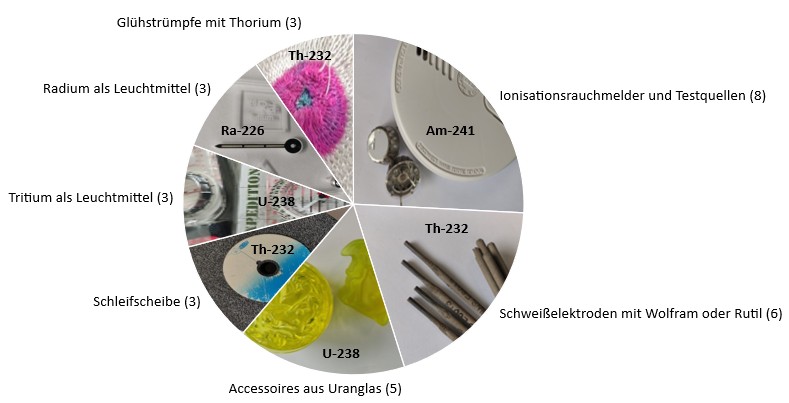
In any case, consumer products must be authorised by the authorities before they are placed on the market. Authorisation is only granted if the use of the consumer product is justified. This means that the use of the consumer product must pose a negligible health risk and that there is no equivalent, non-radioactive alternative to the product.
Authorised consumer products are available on the market without the need for further post-sale monitoring or control. When disposing of consumer products, the instructions for use must be followed.
Important notes:
- The deliberate addition of radioactive substances during the manufacture of foodstuffs, animal feed, cosmetic products, toys and personal jewellery, or their placing on the market, is not permitted.
- In the past, other radionuclides were also used to achieve specific product properties, e.g. radium as a luminous material in watches (largely replaced by tritium) or uranium for colouring glass (replaced by non-radioactive additives). Such products are now only available to a limited extent in high street shops (antique shops, private collectors’ markets), but can occasionally be ordered online.
Contaminated goods
Contaminated goods are products that contain unusually high levels of radioactivity. This increased radioactivity is often due to the raw materials used, which are naturally radioactive. The radioactivity levels of these materials can vary considerably. However, contaminated goods may also have been contaminated with artificial radioactive substances, such as caesium-137.
Contaminated goods are not permitted and must therefore not be placed on the market at all. However, official monitoring of their placing on the market is difficult, particularly as many of these goods are sold via online platforms.
On behalf of the Federal Ministry of Agriculture and Forestry, Climate and Environmental Protection, Regions and Water Management (BMLUK), we carry out regular research and random checks to identify contaminated goods. Furthermore, we are part of a network designed to ensure the rapid exchange of information across Europe when such goods are found.
If it is established that contaminated goods are in circulation, measures are taken – where necessary in cooperation with other European countries – to ensure that these goods are removed from the market.
Contaminated goods often contain the raw material tourmaline
Tourmaline is a mineral used for its antistatic properties. Like many other natural raw materials, tourmaline may contain natural radionuclides, the levels of which can vary significantly. In rare cases, the end products may contain such high levels of natural radionuclides that they must be withdrawn from circulation.
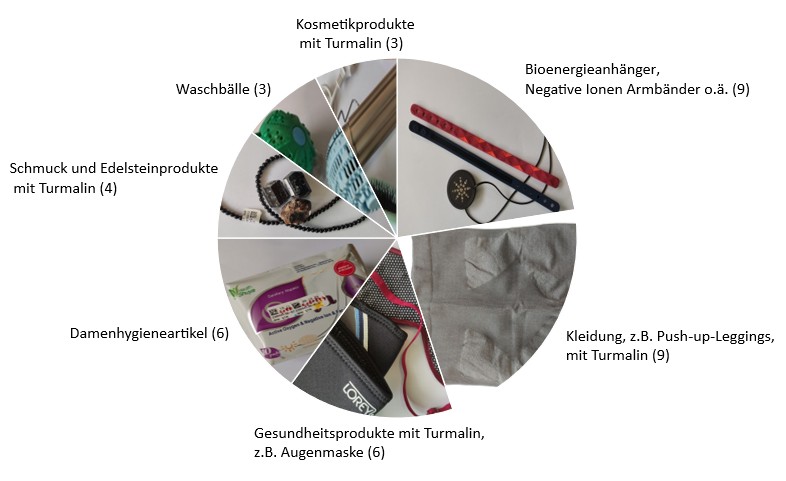
Examples of products that may contain natural radionuclides due to tourmaline (Figure 2):
Bioenergy pendants / Quantum Scalar Energy pendants
Textiles containing tourmaline, such as leggings, sleep masks or kidney warmers
Rheumatism mattresses containing tourmaline
Feminine hygiene products
Jewellery and gemstone products containing tourmaline
Laundry balls
Hairbrushes and curling irons containing tourmaline
For some products, tourmaline is also specified in the product name or description (for example, in curling irons, hairbrushes or leggings). The use of tourmaline is often explicitly advertised due to its intended antistatic effect. However, this effect is not caused by any radioactive substances that may be present.
In the case of so-called bioenergy pendants, the use of tourmaline is now deliberately obscured. According to current knowledge, product names and manufacturer names are also frequently changed (for example, Quantum Scalar Energy pendants and similar products) – presumably because it is now known that some of these pendants contain radionuclides. Wearing such pendants is often touted as having a positive effect on the body. However, there is no scientifically substantiated evidence to support this.
Contamination by artificial radioactive substances
Although radioactivity measurements are carried out in steelworks worldwide, in isolated cases steel contaminated with artificial radioactive substances may enter circulation if radioactive sources (cobalt-60 or caesium-137) are accidentally melted down and processed into products. However, no such cases have occurred in Austria in recent years.
Research and random checks of goods by AGES
We examine products that are already known nationally or internationally as potentially contaminated goods and can be imported into Austria or purchased online, as well as other products identified during our investigations. None of the products examined to date showed a level of radioactivity that had to be classified as a health risk.
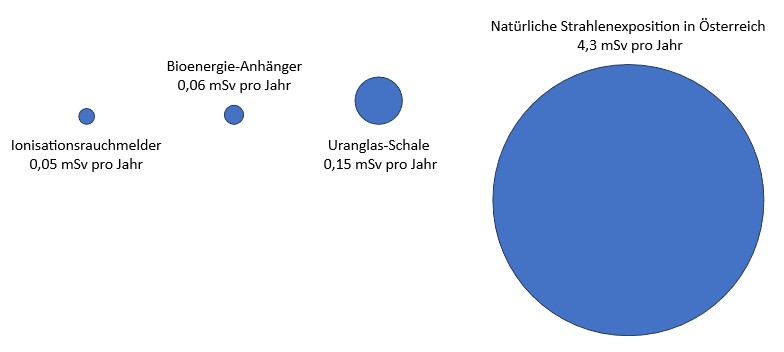
We were only able to detect measurable radiation exposure in a few products. The calculated dose is very low in all cases. For example, wearing the bioenergy pendant with the highest measured value continuously (24 hours a day, 365 days a year) results in an annual dose of 0.06 millisieverts. By comparison, the average dose from natural radiation exposure in Austria is approximately 4.3 millisieverts per year (see also Figure 3).
Note: If you own such items or suspect that a product may be affected, you can arrange for a measurement to be carried out by AGES.
Contact
Leitung
DI Fabian Rechberger
- fabian.rechberger@ages.at
- +43 664 9670975
-
Spargelfeldstraße 191
1220 Wien
Last updated: 12.05.2026
automatically translated