Air pollution
Clean air is essential for our health and our ecosystem. The greatest health risk stems from excessive concentrations of particulate matter, ozone and nitrogen dioxide, as these can contribute to respiratory and cardiovascular diseases. Austria has set itself the goal of implementing the WHO and EU air quality guidelines.
Air pollutants are primarily caused by external factors such as traffic, industry, power stations or incinerators. In the process, undesirable gaseous or particulate substances – such as heavy metals, polycyclic aromatic hydrocarbons (PAHs) and dioxins – are released into the ambient air. These emissions can be transported over long distances and, through precipitation or dust, settle on organisms, water bodies, surfaces or soil. When these pollutants are absorbed by plants or accumulate on surfaces, this is referred to as immission.
Various systems and approaches are used to measure pollutant levels in the air. One of these is known as environmental biomonitoring.
Biomonitoring
Environmental influences and changes can be analysed using biomonitoring. This involves using biological systems, such as plants, to monitor air quality over space and time. This allows conclusions to be drawn about emission sources such as industry and transport.
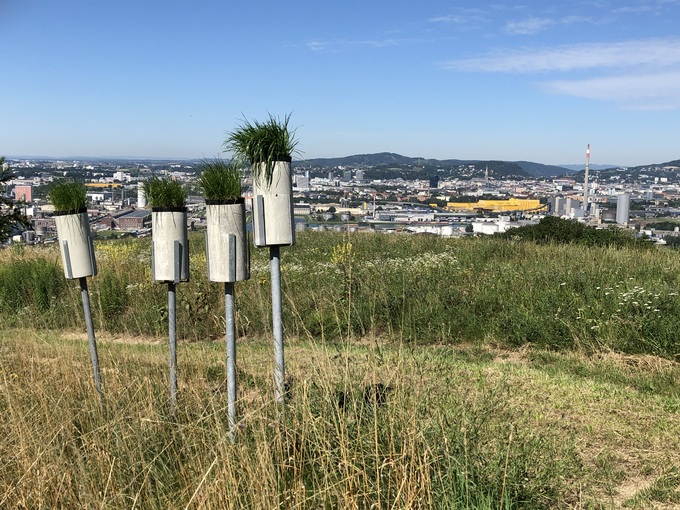
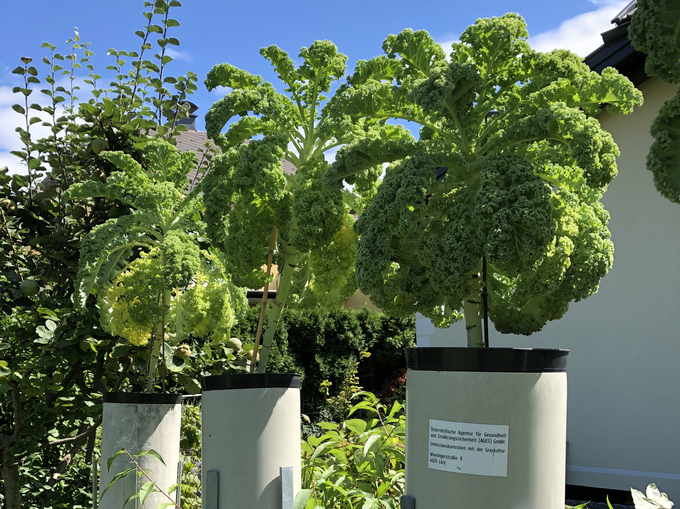
Active biomonitoring systems are primarily used to monitor and track known emission sources. In these systems, Italian ryegrass (Lolium multiflorum) is grown in a greenhouse under specified conditions in accordance with VDI standards (seed, potting soil, fertilisation) as an (accumulation) indicator for animal feed, or kale as an (accumulation) indicator for food. The plants are then transported to the study area, where they are installed at a height of approximately 1.5 metres. After a specified exposure period, the plants are harvested, processed and analysed. The plant pot is subsequently replaced with a new one, enabling several measurement periods to be carried out annually. The analysed results are evaluated and also compared with regional and supra-regional uncontaminated background data.
Passive biomonitoring systems are mainly used following incidents (such as a fire at an industrial plant), but are also employed for supplementary measurements to complement active biomonitoring. In passive biomonitoring, samples are taken from plants growing in the wild – such as meadow grass, tree leaves, dandelions or spruce needles – and analysed. The results of these analyses are also compared and evaluated against regional and supra-regional uncontaminated background data.
Biomonitoring is an essential component of many environmental impact assessment procedures. As an accredited inspection body, we have many years of experience in the field of biomonitoring.
Measurement of environmental pollution using perennial ryegrass as an example
Emissions measurements carried out as part of active biomonitoring are used to monitor air quality over space and time. They enable conclusions to be drawn about potential sources of emissions. In this process, plants grown under standardised conditions are specifically placed in the study area. Italian ryegrass (in accordance with VDI 3957 Part 2) is frequently used for this purpose. Similar methods also exist for other plant species such as kale, dandelion or meadow grass.
Lolium multiflorum is grown in a greenhouse under precisely defined conditions (e.g. seed, potting soil, fertilisation) and then transported to the study area. There, it is exposed at a height of approximately 1.5 m for around four weeks. After the exposure period, the grass is harvested, processed and analysed. The plant pot is then replaced with a new one, enabling at least five monthly measurement periods per year between May and September.
The Swiss ryegrass serves as an accumulation indicator: it absorbs substances present in the air both on its surface and within the plant, thereby making environmental changes visible. By comparing the analysis results with regional and supra-regional background data, the following questions, among others, can be assessed:
- Are emissions detectable that exceed the usual background level?
- How pronounced are these emissions (low, significant, elevated)?
- Do the detected pollutant inputs require further investigations on naturally occurring plants? Are animals, and subsequently humans, at risk to their health from consuming plants growing locally?
Welsh ryegrass is suitable for detecting both inorganic elements such as lead, cadmium, mercury or antimony, and organic pollutants such as dioxins (PCDD/F), polycyclic aromatic hydrocarbons (PAHs), hexachlorobenzene (HCB) or polychlorinated biphenyls (PCBs). Active biomonitoring is used, amongst other things, to monitor emission sources (e.g. industry, transport) and within the framework of large-scale monitoring networks. To evaluate the measurement results, the relevant background data (OmH – guideline values for maximum background concentrations) are consulted and compared with the current measurement results.
Services
Biological exposure measurements
Inspection body in accordance with EN ISO/IEC 17020 (ID No.: 0371). Further information on accreditation and the scope of accreditation: Akkreditierung Austria
Methods (inspection methods)
- Active biomonitoring in accordance with VDI 3957 Part 2 (exposure measurements using standardised grass cultures) and in accordance with VDI 3857 Part 2 (assessment values for exposure-related substance accumulation in standardised grass cultures)
- Passive biomonitoring in accordance with VDI 3957 Parts 1, 3, 5, 10, 11, 15 (immission measurements using plants such as meadow grass, tree leaves, kale, maize plants, etc.)
Applications (examples)
Various EIA procedures, monitoring of facilities (evidence gathering regarding emissions), emission checks following a pollution incident, etc.
Additional services
Assessment and client consultancy
Scope of investigation
- (Harmful) elements, in particular heavy metals
- Organic pollutants (e.g. PAHs, PCBs, HCB, PCDD/F)
Last updated: 01.06.2026
automatically translated