Forty years ago, on 26 April 1986, the nuclear reactor in Chernobyl, Ukraine, exploded. Large quantities of radioactive material were scattered across Europe. Austria was severely affected by radioactive fallout – caused by rainfall in the days following the release: the areas where it rained the most also received the highest levels of radioactive material, known as radionuclides. Particularly in Upper Austria, Salzburg, north-western Styria and parts of Carinthia, elevated levels of the long-lived caesium-137 can still be measured today.
40 years since Chernobyl: some mushrooms still remember it
|
1 min read
Human
Plant
Environment
Research
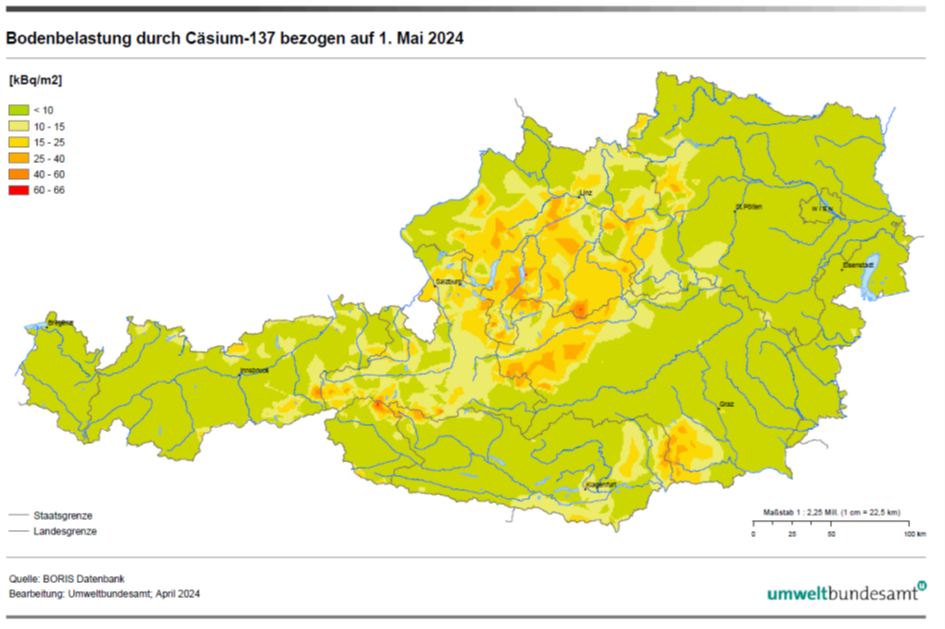
No contamination of food
In arable and grassland soils, caesium-137 is bound to clay particles and is therefore no longer available to plants. Furthermore, on agricultural land, radionuclides are removed during harvesting or carried into deeper soil layers by ploughing. Caesium-137 therefore no longer plays a role in agricultural products. This is also demonstrated by the nearly 1,000 food samples tested for radioactivity each year: here, the levels have returned to those seen before the Chernobyl accident. Only in wild mushrooms and game can higher levels of caesium-137 still occur.
Why some mushrooms still contain caesium-137
Unlike grassland and arable soil, forest soil does not change over long periods of time. Soil samples show that, even decades after Chernobyl, caesium-137 remains mainly in the top ten centimetres of the forest soil. It can thus be taken up by plants and fungi via their roots. It returns to the soil via fallen leaves and dead plant and fungal material, is taken up again the following year, and so on.
We have closely investigated the situation in Austria’s forests over the past few years. A mushroom monitoring programme focused on determining caesium-137 levels in chanterelles, porcini, bay boletes and parasol mushrooms. To this end, mushrooms were collected from sites across many regions of Austria that had been affected to varying degrees by Chernobyl. In a further project, various wild mushrooms such as the lady’s slipper, golden bolete, ochre bolete, frost mushroom, bread-crumb mushroom, trumpet chanterelle and violet lacquer funnel were examined at sites more heavily affected by Chernobyl, as well as mosses, lichens, ferns and soil samples.
It was found that different mushroom species absorb caesium-137 to very different degrees: chanterelles and porcini mushrooms are well below the limit of 600 Bq/kg caesium-137. However, in boletes, russulas and, in particular, honey mushrooms, very high levels of over 2,000 Bq/kg fresh weight were still measured in some cases. A total of 22 mushroom samples exceeded the limit. These exceedances mainly concerned regions with known high soil contamination, as well as mushroom species that absorb particularly high levels of caesium due to their physiology.
Nevertheless, this is not dangerous: the measure of exposure to radioactivity is given in millisieverts (mSv). Even if you were to eat 10 portions of 250 g each of those mushrooms that exceed the limit, you would only be exposed to a maximum dose of around 0.07 mSv: that is less than two per cent of the natural radiation exposure of approximately 4.3 mSv per year to which a person is exposed annually.
|
1 min read
Human
Plant
Environment
Research
automatically translated