Trifluoroacetic acid
In short
TFA (trifluoroacetic acid) is produced from chemical substances used in industry, in plant protection products and in medicines. It is very persistent and can be detected everywhere in the environment – in water, soil, plants and even in food. Humans mainly ingest TFA via food and drinking water, but they excrete it again very quickly.
To better assess the situation here in Austria, we analysed drinking water for TFA in 2025. TFA is present, but in very small quantities, mostly between 0 and 1 µg per litre. 1 µg/l is one millionth of a gram per litre. This would mean that we would find 1 g of the substance in a 50-metre swimming pool containing 1 million litres of water. Even the highest concentration measured, at 6 µg/l, is well below the limit values currently in force in Denmark and Italy. There is currently no Europe-wide limit for TFA in drinking water. In Denmark, the TFA limit in drinking water has been set at 9 µg/l, and in Italy at 10 µg/l.
The European Chemicals Agency (ECHA) has determined that TFA has adverse effects on reproduction. This assessment is based on animal studies which show these adverse effects at doses of 180 mg/kg body weight per day. There are no studies or reports involving humans. By way of comparison: on average, a person in Austria consumes around 50–100 µg of TFA per day via food and around 1–10 µg via drinking water, which equates to approximately 1–1.7 µg per kg of body weight per day. This is around 100,000 times less than the amount administered in the animal studies.
The ECHA’s hazard classification describes the basic properties of chemical substances, but does not make any statements about the actual risk to humans. This is the role of the European Food Safety Authority (EFSA): It has set the Acceptable Daily Intake (ADI) for TFA at 0.014 mg/kg body weight. A person can consume this amount daily throughout their lifetime without any harmful effects on their health. On this basis, limit values for TFA in drinking water and food will be established in future.
According to the current state of scientific knowledge, TFA does not pose a health risk to humans; TFA is primarily an environmental problem. At European level, work is therefore underway on numerous measures to reduce it. Austria has some of the best-quality drinking water in Europe. The majority comes from protected groundwater and spring water sources. Drinking water quality is strictly monitored to ensure long-term security of supply.
Questions and Answers
According to current scientific knowledge, TFA does not pose a health risk to the general public. Based on current understanding, TFA is primarily an environmental issue.
The European Food Safety Authority (EFSA) has set an acceptable daily intake (ADI) of 0.014 mg per kg of body weight (mg = milligram = one thousandth of a gram). This is the amount that a person can consume daily over the course of a lifetime without any harmful effects on their health.
Example: a person weighing 75 kg can consume 1,050 micrograms of TFA per day (1 microgram is one millionth of a gram). If this 75-kilo person eats 1.2 kilos of fruit, vegetables and cereals every day and drinks 2 litres of water, around 100 micrograms of TFA will enter their body. That is only about one-tenth of the amount considered safe.
Profile
Trifluoroacetic acid, or trifluoroacetate (TFA), is a short-chain perfluorocarboxylic acid and the final degradation product of many fluorinated compounds. When fluorinated gases – which are widely used as refrigerants, for example in heat pumps, air-conditioning systems and fridges – are released into the atmosphere, they are chemically altered by UV radiation and converted into TFA. However, fluorinated compounds are also used in plant protection products and medicines, and TFA can be produced from these as well. TFA is very persistent; its high water solubility means that it is highly mobile in the soil and can easily enter the groundwater.
Occurrence
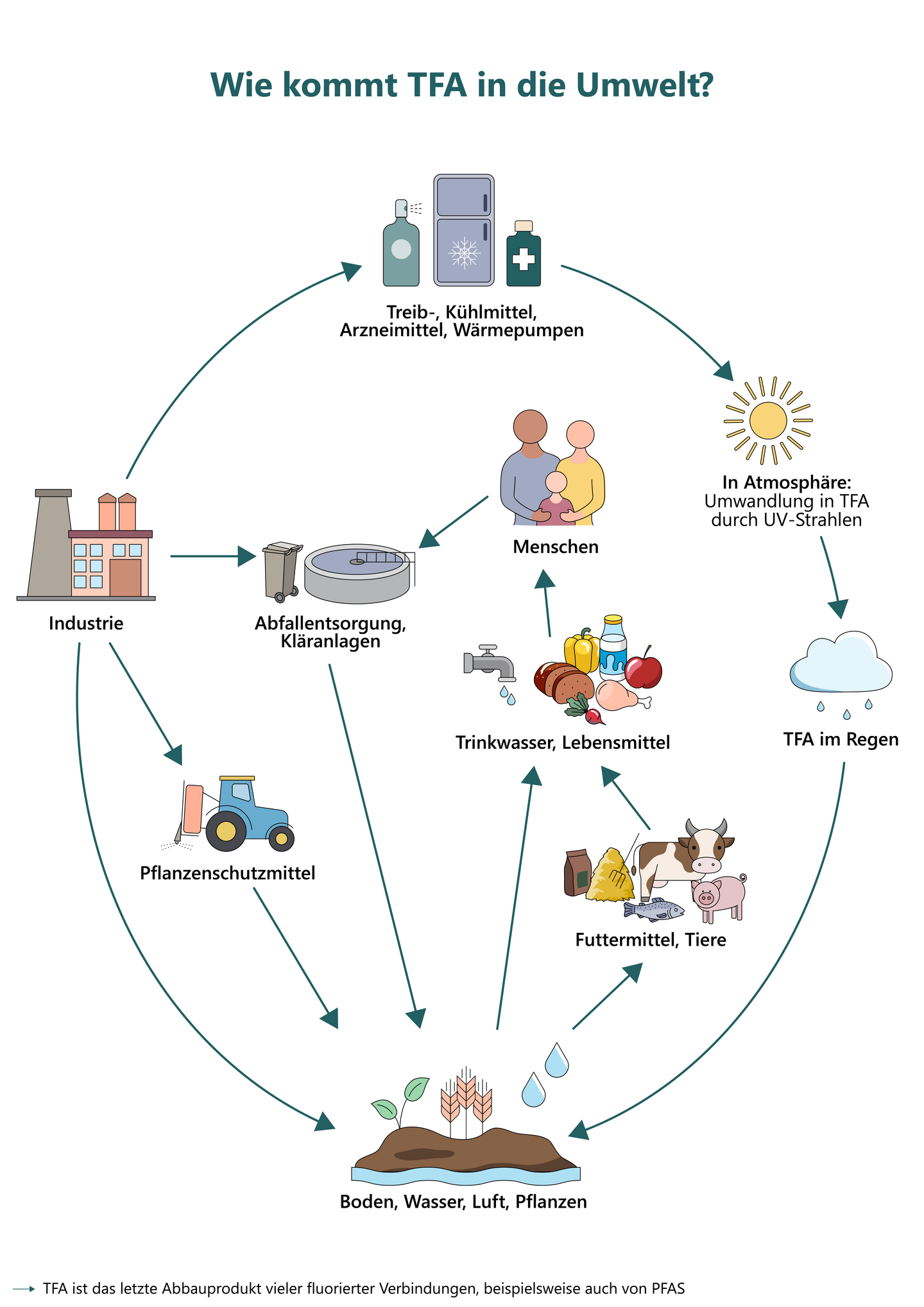
Owing to the widespread use of fluorinated compounds and its persistence, TFA is now present throughout the environment. It can be detected in groundwater, rainwater, rivers, seas, soil and even in plants, with concentrations being highest in summer due to photochemical activity in the atmosphere (Bavarian State Office for the Environment).
The German Federal Environment Agency reports average TFA levels in precipitation of 0.335 μg/L (German Federal Environment Agency 2023).
Health effects
TFA is absorbed via food or drinking water and, to some extent, enters the enterohepatic cycle (the circulation of certain substances in the bodies of mammals between the gut, liver and gallbladder), distributed throughout the body (including the placenta) and rapidly excreted via urine and faeces.
New scientific evidence shows that trifluoroacetic acid (TFA) can impair reproduction and the development of offspring in animal studies. This assessment is based on animal studies which demonstrate these adverse effects at doses of 180 mg/kg body weight per day or higher. There are no studies or reports involving humans.
By comparison, the intake of TFA by a person in Austria via food and drinking water is around 50–100 µg TFA, which is approximately 1–1.7 µg/kg body weight. This is just over 100,000 times lower than the levels observed in the animal studies and is well below the EFSA’s current ADI of 0.014 mg/kg body weight.
The health implications of current TFA intake via drinking water and food have been reassessed by the European Food Safety Authority (EFSA): https://www.efsa.europa.eu/de/news/efsa-lowers-safe-level-exposure-tfa
Situation in Austria
In Austria, TFA has been analysed in groundwater as part of the Water Status Monitoring Programme (GZÜV). TFA is widely detectable in groundwater in Austria. Since 2018, a total of 281 groundwater samples have been analysed for TFA. Of these, concentrations above the limit of quantification were found in 274 samples. The average concentration was 1.4 µg/l, with the highest measured value being 21 µg/l (H2O specialist database – public quality data enquiry).
In 2025, AGES analysed TFA in drinking water as part of an Austria-wide monitoring programme. Of the 331 drinking water samples, TFA was detected in 307 samples (corresponding to 93%) at concentrations above the limit of quantification of 0.1 µg/l. The highest concentration measured was 6.03 µg/l.
There is currently no statutory limit for TFA in drinking water in the EU, and therefore in Austria. The German Federal Environment Agency (2020) has derived a health guideline value of 60 µg/l and points out that a concentration of 10 µg/l or less of TFA in drinking water should be aimed for. In Denmark, a limit of 9 µg/l has been set for TFA in drinking water (Drikkevandsbekendtgørelsen). In Italy, a limit of 10 µg/l for TFA in drinking water has been in force since July 2025 (https://www.gazzettaufficiale.it/eli/id/2025/07/04/25G00106/SG).
The guideline ‘Handling of unregulated contaminants in drinking water, BMG-75210/0023-II/B/13/2014’ stipulates that maximum levels set by other countries may be used to establish derived tolerance levels. Based on the EFSA’s assessment of TFA, it is now possible to derive a tolerance level.
In 2025, the European Commission issued a recommendation on the monitoring of TFA in foodstuffs; on the basis of this, corresponding monitoring of plant-based foodstuffs is currently being carried out in Austria. A final assessment is not yet available. Monitoring of foodstuffs will also be carried out again in 2026.
Technical information
Risk assessment
The European Commission has tasked the EFSA with preparing an opinion on the revision of the toxicological reference values for TFA (“reviewing the toxicological reference values for trifluoroacetic acid (TFA)”). This opinion was published on 21 July 2026.
EFSA identified an extended single-generation study on reproductive toxicity (EOGRTS) in rats, in which a reduction in the thyroid hormone T4 was observed in male rats at a dose of 44.3 mg/kg body weight per day. On this basis, an Acceptable Daily Intake (ADI) of 0.014 mg/kg body weight per day was established for TFA. According to the current state of knowledge, this amount can be consumed daily throughout a person’s lifetime without posing a health risk to humans. Based on the same study, an acute reference dose (ARfD) of 0.07 mg/kg body weight was also defined. The ARfD is the amount of a substance that can be ingested on a single occasion (over 24 hours or a shorter period) without posing a health risk to humans. Both the ADI and the ARfD also provide protection against other toxic effects of TFA, such as developmental toxicity, which has been observed in rabbits.
Furthermore, EFSA and ECHA are working on a joint assessment of the fate and behaviour of TFA in soil and water: “Joint Request to EFSA and ECHA to consider the fate and behaviour of trifluoroacetic acid (TFA) in soil and water.” – Planned duration: 18 months, Dec. 2025 – June 2027, Open EFSA.
In light of new toxicological data on developmental toxicity in rabbits at doses of 180 mg/kg body weight per day or higher, the human toxicological relevance of TFA is currently being reassessed in several renewal procedures for active substances in plant protection products. A metabolite of an active substance in plant protection products is considered to be relevant in terms of human toxicology within the meaning of the Plant Protection Products Regulation (Regulation (EC) No 1107/2009) if there is reason to believe that it possesses certain toxicological properties that are deemed unacceptable.
Hazard and labelling classification by the European Chemicals Agency (ECHA)
The hazard classification and labelling of TFA is carried out by the European Chemicals Agency (ECHA). The assessment by ECHA’s Committee for Risk Assessment (RAC) is based solely on the hazardous properties of the substance and whether it is capable of causing adverse effects. It does not take into account the risk or the extent to which people and the environment are exposed to the substance.
In June 2026, ECHA confirmed that TFA has an adverse effect on reproduction. In early October 2026, the RAC’s final opinion was published on the ECHA website and submitted to the European Commission (EC). Should the EC, in consultation with the Member States and the stakeholders concerned, conclude that an update to the harmonised classification and labelling of TFA and its inorganic salts is appropriate, a corresponding draft regulation to amend the CLP Regulation will be drawn up.
The RAC recommends classifying TFA and its inorganic salts as toxic to reproduction, Category 1B, with the hazard statement (H360Df) regarding adverse effects on development and as toxic to reproduction, Category 2, regarding adverse effects on sexual function and fertility.
A substance classified as ‘toxic to reproduction 1B’ is considered likely to be harmful to human reproduction. This classification is based on conclusive animal studies suggesting that the substance impairs fertility or causes developmental damage in offspring. The hazard statement H360Df indicates the following hazards: “May damage the unborn child. May impair fertility”.
A substance in category ‘toxic to reproduction 2’ is suspected of being harmful to human reproduction. There is preliminary evidence from animal studies or observations in humans, but this evidence is insufficient for a higher classification in Category 1A or 1B.
Furthermore, the RAC recommends classifying TFA and its inorganic salts as persistent, mobile and toxic (PMT) as well as very persistent and very mobile (vPvM). A substance is classified as very persistent and very mobile (vPvM) if it can cause very long-lasting and widespread contamination of water resources (https://echa.europa.eu/documents/d/guest/rac77_final_minutes_en).
ECHA’s current classification of TFA and Germany’s proposed classification can be found here.
ECHA’s classification is used for the hazard labelling and classification of chemical substances for storage, transport and packaging. It does not take into account potential human exposure and makes no statement regarding the risk to humans.
To assess the risk, it is necessary to calculate the amount absorbed through food and drink, via the air and through skin contact. Consequently, EFSA and AGES derive safe, health-based guideline values and carry out health risk assessments for the general population. These serve as the basis for risk management when setting statutory limit values.
OECD definition of PFAS
According to the Organisation for Economic Co-operation and Development (OECD), PFAS are defined as fluorinated substances containing at least one fully fluorinated methyl or methylene carbon atom (without an H/Cl/Br/I atom bonded to it), i.e. with a few exceptions, any chemical containing at least one perfluorinated methyl group (-CF₃) or one perfluorinated methylene group (-CF₂) is a PFAS.
Perfluorinated alkyl substances in drinking water – monitoring
AGES (2025): The Effects of Trifluoroacetic Acid (TFA) in Humans: A Rapid Review
Federal Ministry of Agriculture, Forestry, Regions and Water Management, Federal Environment Agency (2022): Water Quality in Austria – Annual Report 2018–2020. and the H2O specialist database
Leitung
DI Johann Steinwider
- johann.steinwider@ages.at
- efsafocalpoint@ages.at
- +43 50 555 25702
-
Spargelfeldstraße 191
1220 Wien
Last updated: 08.10.2026
automatically translated