Mediterranean fruit fly
Ceratitis capitata
Appearance
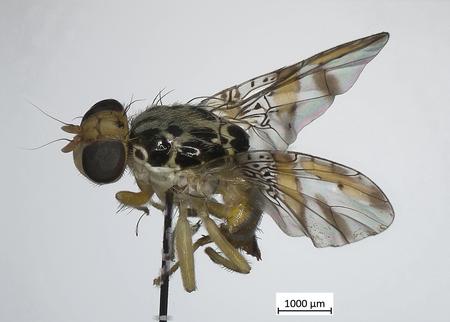
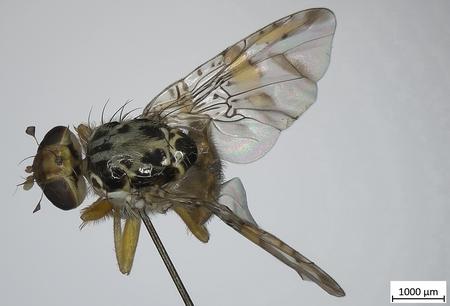
Adult flies are approximately 4–5 mm in length, yellowish-brown in colour, and are characterised by strikingly coloured wings (yellow and black stripes, spots and dots) as well as a distinctive pattern on the back of the thorax. However, there is a risk of confusion with other species of fruit fly.
The larvae of the Mediterranean fruit fly are white to cream-coloured, up to 1 cm long in the final larval stage, and have a black mouth hook.
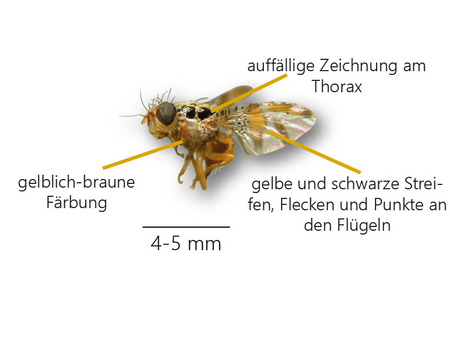
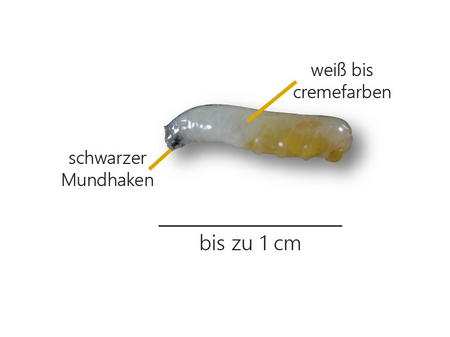
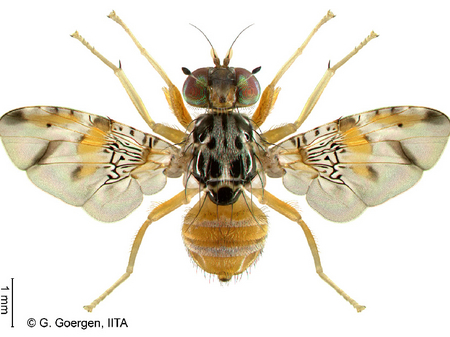
Die Abbildung der adulten Mittelmeerfruchtfliege "Ceratitis capitata" von G. Goergen IITA ist lizenziert unter CC BY 4.0
Biology
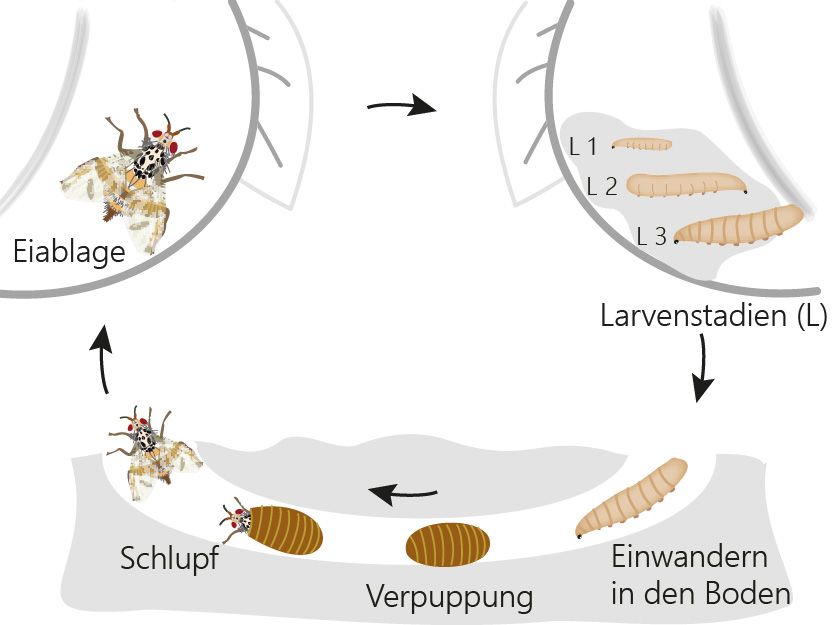
After mating, the females lay their eggs under the skin of ripening fruit. The larvae hatch from the eggs after a few days; they feed inside the fruit and develop there from the first to the third larval stage. They then leave the fruit and drop to the ground. Pupation takes place in the soil beneath the host plant, and the adult flies emerge from the pupae. At optimal temperatures (25–30 °C, laboratory conditions), the Mediterranean fruit fly can complete its life cycle in around three weeks. In its native range, it produces several generations per year, depending on climatic conditions.
Due to the climatic conditions prevailing in Austria, they take longer to develop here, which is why only a small number of generations (approximately one to two per year) can be expected. No evidence of this species overwintering outdoors in Austria was found in large-scale trials carried out in Vienna (see Wernicke et al., 2025). Adult Mediterranean fruit flies can live for several months, and during this time the females can lay several hundred eggs.
Damage symptoms
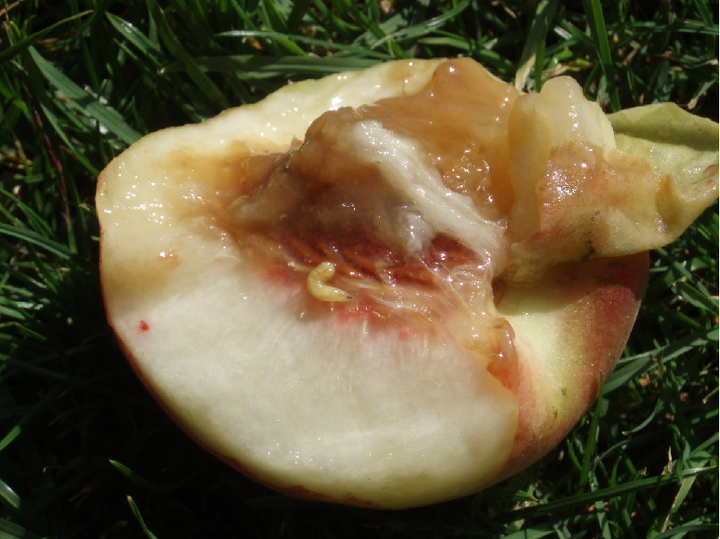
In infested fruit, the punctate injection sites of egg laying can be detected. The larval stages feed inside fruits, destroying the flesh and making the fruits more susceptible to secondary pathogens such as fungi. Since the Mediterranean fruit fly only attacks fruit, there is no damage to other parts of the plant such as leaves, trunk, branches or roots.
Host plants
The Mediterranean fruit fly is a highly polyphagous fruit fly with a wide host plant range of over 200 plant species. In Europe, potential host plants include citrus(Citrus spp.) and peach(Prunus persica), as well as a variety of other fruit-bearing plants (cultivated and wild). These include other Prunus species such as apricot(Prunus armeniaca), but also pear (Pyrus spp.), apple(Malus domestica), medlar(Mespilus germanica), kiwi (Actinidia deliciosa) and mango(Mangifera indica).
In Austria, mainly infested peaches, and in isolated cases apricots and pears, have been found at individual allotment sites in Vienna.
Distribution
The Mediterranean fruit fly is native to Africa, but has been detected on every continent in recent decades. The main cause of its spread is the transport of infested fruit from affected areas via global trade or in travellers’ luggage.
In Austria, the Mediterranean fruit fly has been detected repeatedly over the past century, and surveys in recent years have also shown repeated occurrences, particularly in the north and east of Austria. In Vienna in particular, adult flies have been caught on a recurring basis and infested fruit has been found in allotments; in other federal states, only isolated Mediterranean fruit flies have been caught in traps.
Propagation and transmission
Dispersal of the Mediterranean fruit fly can be active or passive. Active dispersal is by flight of adults up to 20 km, passive by wind dispersal over even greater distances. The most important passive dispersal occurs through the transport of infested fruit (commercial goods, travelers' luggage).
Economic importance
Due to changing climatic conditions (milder winters), there is a medium-term risk of permanent establishment of the Mediterranean fruit fly in our latitudes with negative effects for domestic fruit growing. On the one hand, this concerns direct damage to the fruit, on the other hand, an occurrence poses the risk of potential trade barriers for exports to infestation-free countries.
Prevention and control
- To detect the occurrence (monitoring, prevention): placing suitable traps with specific attractants. Different types of traps and attractants are used (e.g. Delta traps, McPhail traps, fruit fly traps, etc.). However, due to possible mutual interference, attractants for males and attractants for females (often protein-based) may only be used at appropriate distances from each other.
- By means of higher trap numbers the population can be reduced (mass trapping).
- In hobby orchards: wrapping or netting fruit when infestation is feared to mechanically prevent oviposition (physical barrier).
- Hygiene in the orchard: regular removal and harmless destruction of infested fruit. Any larvae that may be present in the fruit should be killed, for example by freezing or deep burial of the fruit. Simple composting without treatment is not sufficient, as the animals can continue to develop in the compost.
- Currently, there are no plant protection products approved against this pest in Austria (see list of plant protection products approved in Austria).
Phytosanitary status
Due to its widespread occurrence in southern Europe, the Mediterranean fruit fly is not classified as a quarantine pest in the EU. An occurrence is therefore not reportable. The EPPO lists the Mediterranean fruit fly on the A2 list (= pest locally present in EPPO region; regulation recommended).
Technical information
Investigation of infestation by the Mediterranean fruit fly
To identify the pest, samples (larvae or adults) may be sent to us (see Plant Health Services), although we would appreciate it if you could contact us beforehand. If sending live specimens, please ensure the containers seal tightly. If sending dead specimens, please ensure they are stored in a cool place prior to transport. Please contact us before sending the specimens.
Research
We carry out ongoing surveys on the occurrence of this and other important fruit fly species in Austria. We also participate in international projects on the subject of fruit flies. Further information can be found under EUPHRESCO and FF-IPM.
Publications
Kolkmann, K., Egartner, A., Lethmayer, C., Wernicke, M., 2025. Ceratitis capitata monitoring in Austria. 64th German Plant Protection Conference, 7–10 October 2025, Technical University of Braunschweig. (Conference proceedings, see p. 814)
Wernicke, M., Egartner, A., Blümel, S., Moraiti, C. A., & Papadopoulos, N. T. (2024): Overwintering potential of the Mediterranean fruit fly (Diptera: Tephritidae) in Austria. Journal of Economic Entomology 117(5): 1983–1994. https://doi.org/10.1093/jee/toae180
Egartner, A., Lethmayer, C., Gottsberger, R., Blümel, S., 2019. Recent records of the Mediterranean fruit fly, Ceratitis capitata (Tephritidae, Diptera) in Austria. IOBC-WPRS Bulletin 146, 143–152.
Lethmayer, C., Egartner, A., 2019. Invasive flies in domestic fruit growing. Besseres Obst 8, 7–8.
Egartner, A., Lethmayer, C., 2017. The Mediterranean fruit fly – current distribution of an ‘old’ new pest. Besseres Obst 6, 10–12.
Lethmayer, C., 2011. Dangerous flies for apples and other fruit. Besseres Obst 12, 4–5.
Links
EPPO information on the Mediterranean fruit fly
EUPHRESCO network (see project acronyms FLYDETECT and FruitFlyRiskManage)
FF-IPM: Fruit Flies In-silico Prevention and Management
Last updated: 29.09.2026
automatically translated