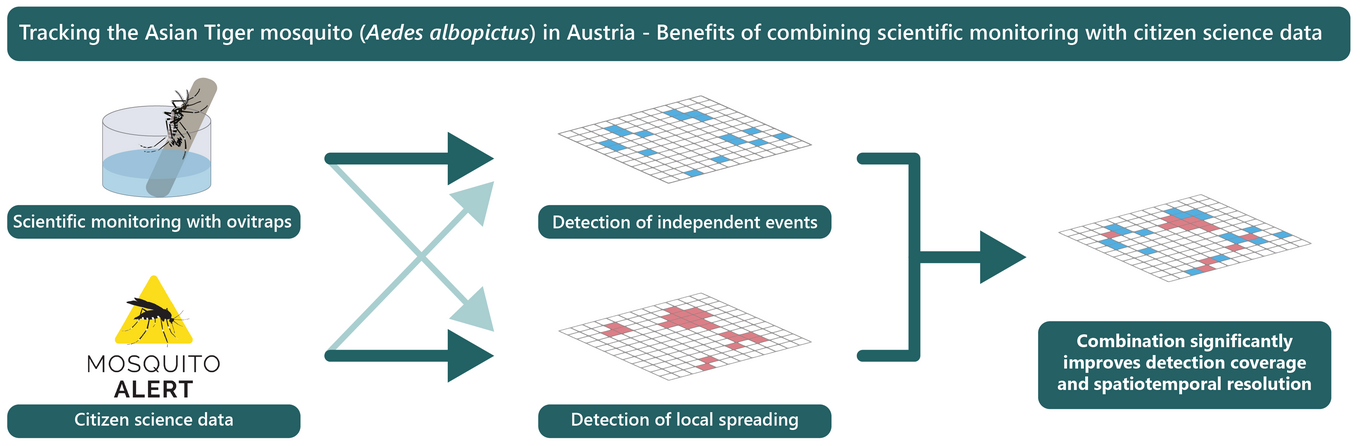
As part of the Ovitrap monitoring programme, Ovitraps (‘egg traps’) are set up every year at over 60 locations across Austria, mainly in urban or suburban areas and at sites where non-native species may be introduced into the country (e.g. motorway service stations). The traps are checked weekly from May to October and examined for mosquito eggs.
Mosquito Alert is a citizen science project that makes it easy to report tiger mosquitoes and other mosquitoes using a free app. The photos submitted are assessed by national and international experts, and the sightings are then displayed anonymously on a publicly accessible map.
Study shows benefits of both methods
In a study, we analysed whether combining both methods yields measurable benefits. To this end, we used data from both projects covering the years 2020 to 2024: We analysed how many tiger mosquitoes were found in areas roughly the size of a local authority (5 × 5 km²) and a district (20 × 20 km²), when they were found, and whether the spread of tiger mosquitoes in these areas could be traced.
The result: Ovitraps are effective at detecting new occurrences of the tiger mosquito, often before they reach a level at which they become noticeable to the public and start to be considered a ‘nuisance’. However, some new occurrences are also first detected via Mosquito Alert – Ovitrap traps cannot be deployed across the entire area. Above all, the data from Mosquito Alert allows the local spread, for example in urban areas, to be monitored very effectively. Please use Mosquito Alert: the more reports we receive, the better we can track the spread of tiger mosquitoes.