Uses
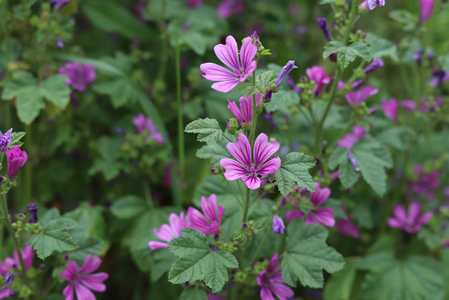
Mallow leaves have a long tradition in local folk medicine and are used, for example, in herbal teas. Thanks to their vibrant purple colour, mallow flowers are also often used as so-called ‘decorative herbs’ in tea blends to give them a more appealing appearance.
For medicinal purposes, the leaves of the upright wild mallow (Malva sylvestris L.) or the prostrate common mallow (M. neglecta Wallr.) are predominantly used. Mallow flowers are obtained only from the large-flowered wild mallow, and preferably from varieties with particularly dark flowers, as the common mallow has only small, pale-coloured flowers.
Both medicinal substances are used to treat irritation of the mucous membranes in the mouth and throat and the associated dry, irritable cough (similar to the closely related marshmallow). In addition, preparations made from mallow leaves have proved effective for mild inflammatory conditions in the gastrointestinal tract. It is believed that the mucilage they contain has a protective, coating effect on inflamed mucous membranes.
Although extracts made with cold water are often recommended, the usual method of preparing tea with hot water is preferable, as the mucilage is stable and hot water significantly reduces the natural bacterial load.
The main constituent found in the leaves and flowers is plant mucilage. These are biopolymers made up of sugars (polysaccharides), whose molecular structure is such that they swell when exposed to water. Important sugars (monosaccharides) in mallow mucilage include galactose, glucose, arabinose, xylose, rhamnose and galacturonic acid. The leaves also contain flavonoids, whilst anthocyanins are responsible for the colour of the flowers.
Botany
The two species of mallow used in pharmaceuticals and found growing wild in this region – Malva sylvestris L., the common mallow, and Malva neglecta Wallr., the roadside mallow or small cheese poplar – belong to the mallow family, Malvaceae.
The flowers of this family are radially symmetrical (the flower can be divided into two equivalent halves by at least three planes of symmetry) with five coloured, free petals that are twisted whilst still in the bud. These colourful petals are surrounded by a three-lobed, green outer calyx. In the centre of the flower, numerous stamens (the male part of the flower) are fused into a tube. They surround the female part of the flower, the pistil. The flowers of the wild mallow are large. Their petals are two to four times as long as the calyx and range in colour from intense pink to dark violet with dark longitudinal stripes. The flowers of the common mallow are slightly smaller, pale purple-lilac to (almost) white with three dark longitudinal stripes and long-stalked. Their petals are only twice as long as the calyx.
The leaves of both the above-mentioned mallow species are stalked, palmately lobed and indented at the base. They are also serrated to saw-toothed at the margin and more or less hairy. The stem leaves of both species are three- to seven-lobed; in *Malva sylvestris* they are lobed to about half their length, whilst in *Malva neglecta* they are lobed to only a quarter of their length.
The stem is often prostrate to arching, occasionally erect, branched and with alternate leaves.
Both mallow species delight us with their flowers from June to October. The numerous male stamens are fused into a tube surrounding the style and are full of spiny pollen.
The individual parts of the dehiscent fruit are arranged in a disc-like structure and resemble a wheel of cheese, hence the name ‘cheese poplar’. Each contains a single seed and can be propagated via this seed.
Distribution
The genus Malva comprises 30 species worldwide, twelve of which are found in Europe and seven in Austria.
The two described mallow species are native to the Mediterranean region, the whole of Europe, the Near East and Western Asia. They grow in dry to moderately fresh ruderal meadows (fallow land), such as roadsides, dry fields, in gardens and hedges, as well as on rubble heaps. As nitrogen feeders, they seek proximity to humans. Both species are common to scattered in the colline (flat to hilly) to submontane altitudinal zones and can be found in all of Austria's federal states.
Service
The preservation of diversity is very important to us, which is why we store around 5,400 samples of seeds and plants in our gene bank. With the gene bank for agricultural crops, medicinal and aromatic plants, we are making a significant contribution to the preservation of biodiversity.
Last updated: 28.09.2026
automatically translated