Newcastle Disease
NCD
Occurrence
Newcastle disease is found worldwide. Thanks to control measures, the disease had become less prevalent in recent years. In July 2018, an outbreak was reported in domestic poultry in Belgium. Since then, there have been significant increases in hobby and small-scale flocks in several EU countries, suggesting wider circulation of the virus. In addition, there has been an increase in outbreaks in commercial poultry flocks. The outbreaks are heavily concentrated in Central and Eastern Europe, particularly in Poland, but Germany is also reporting an increase in outbreaks of Newcastle disease in domestic poultry (see Situation in Europe).
Situation in Austria
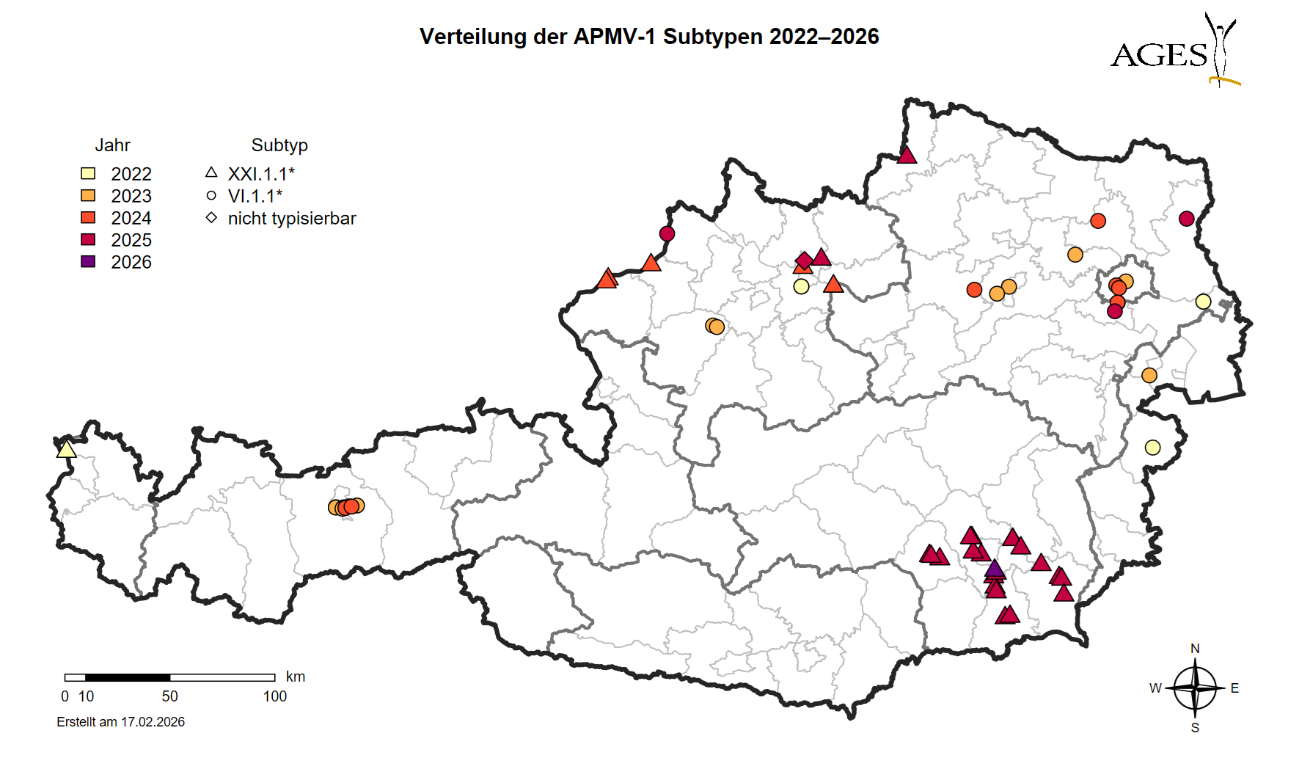
Newcastle disease was last detected in poultry in Austria in 1997. However, it occurs sporadically in wild pigeons and very rarely in domestic pigeons.
Newcastle disease is a notifiable animal disease. The occurrence of clinically suspicious symptoms must be reported to the official veterinarian, who will take samples and send them for testing. Only infections with highly virulent virus types that are detected by molecular genetic methods or assessed according to a pathogenicity index (ICPI 0.7 or higher) are considered to be an outbreak of the disease. If an outbreak of Newcastle disease is detected, all birds in the affected flock must be killed in accordance with the Animal Health Law (AHL).
Poultry farmers should ensure that biosecurity measures are observed: direct and indirect contact between poultry and wild birds should be prevented as far as possible. If animals on poultry farms show signs of health problems, a veterinary examination must be carried out to rule out Newcastle disease. Please note that all poultry farming must be reported to the relevant district administrative authority. For early detection and to prevent further spread, dead wild pigeons must be reported to the local district administrative authority (official veterinarian). Such animals should not be touched and should be left where they are found. The authorities will arrange for their recovery and examination.
specialist information
The causative agent of Newcastle disease is the Newcastle disease virus (avian avulavirus 1, APMV-1), a single-stranded RNA virus from the Paramyxoviridae family. NDV is classified in the genus Avulavirus. A distinction is made between apathogenic, lentogenic (low virulence), mesogenic (low virulence) and velogenic (high virulence) virus types. The symptoms depend on the virulence of the pathogen.
In the bone marrow and muscles of slaughtered poultry, the NCD virus remains infectious for 6 months at -20 ⁰C and up to 134 days at 1 ⁰C. In contaminated poultry houses, the virus remains infectious for 25-30 days, depending on the ambient temperature. The virus can remain infectious for years if it dries out.
Transmission can occur via the air, directly or via objects. The spread of the disease is facilitated by the high tenacity of the virus and its broad host spectrum. Sources of infection are often clinically inapparent infected, sick animals or animals in the incubation period.
NDV is excreted in large quantities via faeces, eye, nose and throat secretions and all other body fluids. Virus excretion begins during the incubation period and, depending on the bird species affected, can last from 1-2 weeks to several months or about 1 year; in vaccinated animals, it lasts about 2 weeks. The pathogens are spread directly from animal to animal as well as indirectly via all equipment, stable dust and air, shoes and vehicles. Transovarial virus transmission plays a major role, with infected chicks hatching from eggs contaminated with NCD virus.
The trade in live or slaughtered poultry and poultry products plays a role in the introduction of the disease into disease-free regions (introduction also via frozen poultry!). Virus transmission is also possible via the feeding of kitchen waste, litter, feed, stable equipment and transport containers. In comparison, the probability of transmission via wild birds is low. With regard to wild birds, waterfowl and wild gallinaceous birds are a natural reservoir for epidemics.
Newcastle disease is widespread worldwide. Control measures have reduced the significance of the disease in recent years. In July 2018, an outbreak was reported in domestic poultry in Belgium. Since then, there has been a significant increase in hobby and small-scale farming in several EU countries, indicating a wider circulation of the virus. In addition, there has been an increase in outbreaks in commercial poultry farms. The outbreaks are heavily concentrated in Central and Eastern Europe, particularly in Poland, but Germany is also reporting an increase in outbreaks of Newcastle disease in domestic poultry.
Since April 2025, compulsory vaccination of all commercial poultry flocks has been in place in Poland. In addition, intensive surveillance and stricter biosecurity requirements have been introduced as control measures. On 26 January 2026, the EU adopted an extended Implementing Decision (EU) 2026/243 on emergency measures in relation to outbreaks of Newcastle disease in Poland, which tightens emergency measures against ND in Poland and redefines protection and surveillance zones.
Diagnostics
At the National Reference Laboratory for Newcastle Disease (NRL, AGES Mödling), we analyse various bird samples for the presence of APMV-1 virus genome using real-time RT-PCR. Positive detections are further subtyped and confirmed by sequencing, egg culture and haemagglutination test (HA).
Real-time RT- PCR and sequencing:
Primary laboratory diagnosis is made by direct pathogen detection from tracheal/oropharyngeal (throat) and cloacal swabs and from animal carcasses (CNS, lung, liver, kidney, heart, intestine) using specific molecular biological methods (real-time RT-PCR). In the case of detection of NCD viruses, confirmatory methods are used to differentiate between virulent and avirulent subtypes. The NRL can differentiate between all currently occurring subtypes using DNA sequencing.
Whole genome sequencing is performed on selected samples (approx. 15.9kb). Enrichment is performed directly from clinical samples using a special RT-PCR, sequencing is performed using modern high-throughput devices (Next Generation Sequencing).
ELISA: The enzyme-linked immunosorbent assay is an antibody-based detection method. Antibodies present in the serum (vaccine and infection antibodies) bind to a specific antigen and are measured qualitatively or semi-quantitatively by means of an enzymatic colour reaction.
Haemagglutination inhibition test (HI): Special antibodies can prevent the agglutination (clumping) caused by the virus. In this way, antibody titres and specific antibodies directed against individual APMV-1 virus strains can be determined.
Virus cultivation in egg culture: A potentially infectious vaccine solution is prepared from the samples and used to inoculate guaranteed virus-free chicken eggs. These eggs are incubated for at least five days. If highly virulent APMV-1 viruses are present, the embryos in the eggs die and the virus in the allantios can be identified by haemagglutination (HA).
Haemagglutination test (HA): Certain viruses, such as APMV-1 viruses, use haemagglutinin to bind erythrocytes to their surface. This causes the blood to agglutinate (clot). The amount of virus can be determined by means of dilution series.
Differential diagnosis includes all diseases with
- acutely increasing mortality
- respiratory disorders
- disorders of the central nervous system (CNS)
- drop in laying performance
- Reduction in weight gain
- petechial haemorrhages due to seroses
z. e.g. avian influenza, avian cholera, infectious bronchitis, infectious laryngitis, Marek's disease, mycoplasmosis, deficiency symptoms, septic forms of bacterial infections.
In the event of the slightest suspicion, the official veterinarian responsible must send the legally prescribed samples to the National Reference Laboratory.
Sample type for sampling:
Live animals:
- Throat and cloacal swabs (dry, sterile, no bacteriological swab transport medium)
- Serum
Samples from dead animals:
- Organ material especially brain, lung, liver, kidney, heart, intestine
- Sample transport and short-term storage: at +4 °C
Contact
Institut für veterinärmedizinische Untersuchungen Mödling
- vetmed.moedling@ages.at
- +43 50 555 38112
-
Robert Koch-Gasse 17
2340 Mödling
Last updated: 11.06.2026
automatically translated