Health promotion during pregnancy & breastfeeding and for children up to the age of 10
A healthy lifestyle begins in the womb. Even the mother's preferred eating habits during pregnancy can shape her children's later eating habits and taste preferences for the rest of their lives. Nutritional deficiencies acquired during pregnancy and up to the end of the second year of life are very difficult to compensate for later in life.
To promote a balanced diet adapted to the needs of the child and as a practical guide to a healthy lifestyle during pregnancy and breastfeeding, we launched the"Eat right from the start!" programme in collaboration with the umbrella organisation of Austrian social insurance institutions and the Federal Ministry of Labour, Social Affairs, Health, Care and Consumer Protection (BMASGPK).
Eating right during pregnancy and breastfeeding
Proper nutrition during pregnancy and breastfeeding is important to ensure the supply of energy and nutrients for the growth and development of the baby and to provide the mother with all that she herself needs.
Important nutrients are delivered to the baby through breast milk, and depending on what the nursing mother consumes, the taste of breast milk also changes. The mother's diet during pregnancy and breastfeeding can also help influence the baby's preferences for certain tastes.
Calorie requirements during pregnancy and breastfeeding
Pregnant women have increased calorie needs, but still don't need to eat for two! It is not until the 13th week of pregnancy that calorie needs increase, which can be met by an additional small snack (1 extra portion of cereal products, 1 extra portion of fruit/vegetables and 1 extra portion of dairy products). From the 28th week of pregnancy, the mother needs a little more. Thus, 1 extra portion of vegetable oil is recommended, which can also be offered in the form of nuts and seeds. The additional need from the 28th week of pregnancy can be covered by another additional small snack or by a larger meal. During breastfeeding, the mother needs the same number of calories as is recommended at the end of pregnancy - but only as long as exclusive breastfeeding is taking place.
Vitamins and minerals during pregnancy and breastfeeding
The need for vitamins (vitamins of the B group - vitamins B1, B2, B6, B12, folate, niacin - and the antioxidant vitamins A, C, E) and minerals (iron, zinc, iodine, phosphorus and magnesium) increases more than the energy requirement during pregnancy and breastfeeding. To ensure that mother and child are well nourished, it is important to have a proper and varied selection of foods with a high content of vitamins, minerals and other protective substances. Therefore, the quality of food plays a special role.
Fluid intake during pregnancy and lactation
During pregnancy and breastfeeding, it is also important to ensure adequate fluid intake. During pregnancy, at least 1.5 liters of drinking water or non-alcoholic and low-energy drinks should be consumed. From the breastfeeding period onwards, an extra portion is added.
Recommendations for a healthy lifestyle during pregnancy and breastfeeding
As a precaution, the consumption of stimulants such as caffeinated beverages should be limited. During pregnancy, stimulants such as alcohol and cigarettes should be completely avoided. To avoid excessive weight gain during pregnancy, mothers should not only eat fewer pastries and sweets, but also take more regular exercise. Regular exercise during pregnancy can have positive effects on both mother and child. For example, daily exercise of 30 minutes in the form of walking, Nordic walking, cycling and water aerobics is recommended. High-intensity or excessive sports, on the other hand, should be avoided.
In order to inform pregnant and breastfeeding women about the current dietary recommendations and about the right choice of food during pregnancy and breastfeeding, "The Austrian Food Pyramid for Pregnant and Breastfeeding Women" was developed. Here you will also find information about what else should be avoided during pregnancy and breastfeeding.
Further information:
- the right nutrition during pregnancy and breastfeeding can be found under"Eat right from the beginning!"
- the right choice of food during pregnancy and breastfeeding under "The Austrian food pyramid for pregnant and breastfeeding women".
Supplemental food recommendations
As part of the program"Eating right from the start!" program, the "Austrian recommendations for complementary foods" and the "Recommendations for the nutrition of one to three year old children" and recommendations for the nutrition of four to ten year old children were developed together with experts in the field of nutrition and child health. Thus, for the first time, uniform information based on the current state of science is available on the introduction of solid food (complementary feeding) and on the nutrition of infants and children from four to ten years of age. The recommendations in detail can be found on the website of the program"Richtig essen von Anfang an!" website.
The new recommendations primarily take into account the infant's individual stage of development and allow parents to respond to their child's needs.
Age at the introduction of complementary feeding
In the first months of life, a baby is well provided for with breastfeeding or infant formula (pre-feeding), but later the baby needs more. The introduction of solid foods (complementary foods) should begin between the beginning of the 5th month of life (17th week) and the end of the 6th month of life (26th week), depending on the infant's individual stage of development. However, breast milk and infant formula remain an important source of nutrients after this time.
Supplemental feeding recommendations for gruel sequence.
There is no order in introducing complementary foods, but it is important that it is done slowly and step by step. In the beginning, readily available sources of iron and zinc, such as meat and cereals, are important for optimal nutrition.
Recommendations for complementary feeding are regularly scientifically reviewed and adapted. Whereas a few years ago the administration of allergenic foods was discouraged, this principle has long since ceased to apply. Avoiding allergenic foods has no preventive effect. On the contrary, there is evidence that fish consumption in the first year of life has a protective effect on the development of allergic diseases. Parents are free to decide when to offer their children complementary foods, whether in the morning, at lunchtime or in the evening.
Recommendations for the intake of liquids with complementary food
No additional drinks are necessary during exclusive breastfeeding. If complementary feeding is started, fluids can be offered as needed. However, after 10 months of age, a child needs regular fluids in the form of beverages, ideally drinking water.
There are foods that are not suitable for infants. Salt, sugar, honey and sweeteners should be avoided - this applies especially to drinks. Infants and toddlers should also not eat whole or coarsely chopped nuts and peanuts: These can be inhaled and get into the lungs. Finely grated and mixed with porridge, they do not pose a problem. You should also avoid fatty predatory fish such as tuna, swordfish, halibut, pike, butterfish, king mackerel - they are most likely to be contaminated with heavy metals. Char, salmon and trout are good choices.
With our online tool "Food under the magnifying glass" you can compare the nutrient content, especially the sugar and salt content, in infant and toddler products, squash.
Learning to eat through imitation
Infants are naturally critical of new foods. It is important that a child not be forced to eat. Rather, parents should offer new foods several times and be a good role model themselves. Children learn by imitation. The parents' eating behavior shapes the child's eating behavior.
Further information on proper nutrition for children up to the age of 10 can be found here.
Checklist for healthy school meals
Children and young people spend a lot of time at school. School is a place of learning and social interaction. Increasingly, pupils are eating not only their snacks but also their lunches together. Healthy school meals help pupils to eat healthily and cope well with everyday school life.
As part of the "Eat right from the start!" programme, a tool has been developed for schools and their administrators to help them design school meals: the "School Meals Checklist".
The checklist can be used for self-assessment and provides an overview of which areas of healthy school catering are already being met and where there is still room for improvement. A detailed accompanying document with lots of in-depth information, tips and links also provides further support for implementation. Both documents are intended to support not only school administrators but also all other persons who play a role in the design of school catering (e.g. head teachers, educators, parents/guardians, caterers).
The "Checklist for School Catering" was drawn up by experts in the field of communal catering and nutrition and unanimously approved by the National Nutrition Commission (NEK).
Guidelines for school canteens: promoting healthy school meals
The "School Canteen Guidelines" contain recommendations regarding the product categories offered in school canteens and are an important tool for implementing healthy break-time catering in Austrian schools. The School Canteen Guidelines were unanimously adopted and approved by the National Nutrition Commission (NEK).
In addition to the criteria for the range of products on offer at school buffets, the guidelines also contain information on the general conditions (such as cooperation within the school) as well as criteria for stocking drinks and snack vending machines. Checklists are also available for an initial self-assessment of the range of products on offer at school buffets and in vending machines.
Evaluation tool for the School Buffet Guidelines
Building on the School Buffet Guidelines, AGES has developed an evaluation tool: this tool allows the range of products at the school buffet to be recorded and assessed objectively and in a standardised manner against the criteria of the School Buffet Guidelines. The evaluation tool was developed on behalf of the Federal Ministry of Labour, Social Affairs, Health, Care and Consumer Protection (BMASGPK).
Training on the evaluation tool As part of the Community
Catering Competence Centre, AGES offers training on the evaluation tool for public sector implementers in the federal states. The training is delivered in cooperation with the Healthy Austria Fund (FGÖ).
Centre of Excellence for Institutional Catering
The Centre of Excellence for Institutional Catering is an information and exchange platform for all those involved in institutional catering in educational establishments, such as nurseries, crèches and schools. It has been established within AGES since 2024. The Competence Centre for Institutional Catering operates on behalf of the Federal Ministry of Labour, Social Affairs, Health, Care and Consumer Protection (BMASGPK) and in cooperation with the Healthy Austria Fund (FGÖ).
The activities of the Competence Centre for Community Catering focus on health-promoting catering for children and young people in educational institutions. This is achieved, amongst other things, by further publicising the national recommendations on community catering and by networking all public bodies in the federal states.
Website of the Competence Centre for Community Catering
On the website of the Competence Centre for Community Catering, interested parties will find an up-to-date overview of recommendations, guidelines and practical implementation aids, as well as recipe ideas for healthy eating. The website is aimed at everyone responsible for catering in educational establishments – such as nurseries, crèches and schools – and serves as an information platform. The website
also provides links to the public advisory centres in the federal states. This enables interested nursery and school managers, teachers and catering providers to quickly find support in implementing measures in nurseries and schools.
Food under the microscope
As part of the JANPA (Joint Action on Nutrition and Physical Activity) pilot project, the Centre for Nutrition and Prevention developed a nutrient database based on an international model, focusing in particular on product groups relevant to children, and implemented this in our project "Food under the microscope" (LeLu for short). In the "LeLu" project – co-financed by funds from the "Joint Health Targets from the Framework Pharmaceutical Agreement" – our Centre for Nutrition and Prevention has been collecting and evaluating data on product categories specifically aimed at children since autumn 2017. The results are intended to make nutritional values comparable and encourage food companies to reformulate their products (e.g. by reducing salt, sugar and fat). The results are also intended to help parents and caregivers compare foods and make healthier and more informed purchasing decisions. More information can also be found in the Nutrient Monitoring Report 2017–2021.
Austrian nutritional profile
Children are regularly exposed to advertisements for foods and beverages that are excessive in energy, fat, sugar, and salt (HFSS). Marketing such foods to children can, for example, have negative effects at an early age by encouraging the development of preferences for certain "unhealthy" foods, taste preferences, and dietary habits, thus contributing to the development of obesity at an early age.
To guide the promotion of foods high in energy, fat, sugar or salt to children before, during and after children's programs, an "Austrian Nutrient Profile for the Guidance of Food Advertising to Children in Audiovisual Media" was developed.
The Austrian Nutrient Profile is based on the "Nutrient Profile Model"ofthe World Health Organization (WHO). The WHO model was adapted to Austrian conditions. Among other things, the Austrian model was adapted to national recommendations (such as nutritional recommendations for children aged 4 to 10) and to the Austrian product range and takes into account the EU "Pledge Nutrition Criteria White Paper".
The Austrian Nutritional Profile was developed as part of the health promotion program "Richtig essen von Anfang an!" (Eating right from the start!) and discussed and agreed upon by experts in the National Nutrition Commission.
The recommendation of the National Nutrition Commission on the guidance of food advertising to children in audiovisual media is intended as an aid for those who work with this topic or design advertising. The recommendation is intended to provide support in assuming the great responsibility of protecting children's health.
To promote healthy eating habits in children
Healthy snacks for children
Most children know that fruit and vegetables are healthy. However, their lunchboxes often contain other foods. The EU school programme for milk, fruit and vegetables was set up to encourage children and young people to eat healthy snacks more often. On the one hand, it promotes the distribution of fruit, vegetables, milk and dairy products to childcare facilities and schools across Europe. On the other hand, schoolchildren can take part in tastings. They also learn more about the diversity, manufacture and production of these foods on trips to farms, and this knowledge is reinforced through the purchase of raised beds, fruit trees and shrubs. All children benefit equally from participating in the EU school programme, as the subsidised foods are cheaper. Teaching materials are also available for educators to support them in their everyday school work.
Under our leadership, teaching materials and videos were created with funding from the European Union on behalf of Agrarmarkt Austria.
The EU school programme is supported by the Federal Ministry of Agriculture, Forestry, Climate and Environmental Protection, Regions and Water Management, the Federal Ministry of Labour, Health, Social Affairs, Care and Consumer Protection, and the Federal Ministry of Education.
Professional quiz for children
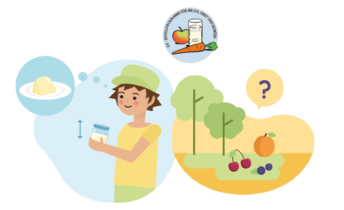
Can you make butter yourself? Which fruits grow on trees?
Not all children can answer these questions easily. That is why quiz questions on the topics of milk, fruit and vegetables were compiled as part of the EU school programme. Children between the ages of 6 and 10 can use these to learn more about agricultural products, the environment and ingredients. Divided into two areas (milk and fruit/vegetables), there are 20 questions in different categories.
The quiz questions are available for download as a PDF file or can be answered online (desktop version).
Experiments for children
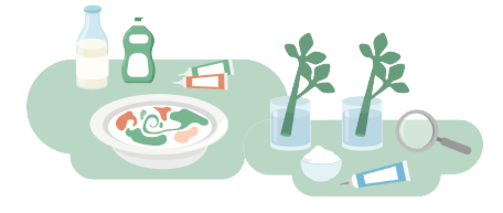
Why does a grated apple turn brown? How is cream cheese made?
To explore these questions in the classroom, ten different "experiments for school lessons" on the topics of milk, fruit and vegetables were developed as part of the EU school programme.
In addition to the necessary materials, the instructions include the exact steps to be taken and interesting facts about the principles behind the effects to be observed. There are also videos of the experiments that can be used for demonstration purposes in class – either in advance as instructions or afterwards to check the results. A research protocol helps young researchers to formulate their own hypotheses. The learning effect can be checked using a set of questions on the respective experiments (knowledge check available for download as a PDF or online).
The teaching materials for the experiments are available for download as PDF files or can be answered online (as a desktop version). The teaching materials supplement existing product deliveries to schools participating in the EU school programme.
Healthy eating catches on in schools – videos for children
As part of the EU school programme, videos have been created specifically for the target group of educational professionals, parents and other caregivers, and children: five animated videos provide easy-to-understand tips and information on the topics of milk, fruit and vegetables. In two further videos, children and nutrition experts discuss questions and answers about the foods mentioned and recommendations for them.
Further useful digital materials and links can be found on the website of the EU school programme of Agrarmarkt Austria.
Last updated: 16.04.2026
automatically translated