Oriental fruit moth
Grapholita molesta
Appearance
The moths of the peach twig borer (Aspila molesta) are dark grey in colour and, when at rest, hold their wings in a roof-like position over their bodies. When spread out, their wingspan measures 10–16 mm. Peach leaf roller moths can be confused with moths of other leaf roller species (e.g. plum leaf roller, Aspila funebrana). Accurate identification can only be carried out in the laboratory using microscopic specimens or molecular biology.
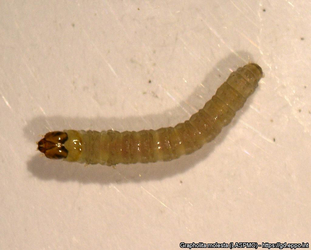
The caterpillars grow to a length of up to 12 mm and are reddish in colour, with a brown head capsule.
The eggs are about 0.7 mm in size, initially transparent and later whitish to yellow in colour.


Biology
The peach moth is assigned to the moth family (Tortricidae).
After hibernation in the last larval stage, which survives protected in a cocoon in bark or in crevices in the ground, the larvae (caterpillars) pupate at temperatures above 10 °C. The first generation of moths (adults) emerge from the cocoon at the end of April. From the pupae, the moths (adults) of the first generation hatch around the end of April. Soon after hatching, females begin laying eggs on leaves, near the shoot tips of young twigs, or on smooth-skinned fruit. Each female can lay up to 200 eggs. The egg stage lasts about three to five days, but somewhat longer at temperatures below 20°C. The caterpillars that hatch from these eggs feed and develop mostly in the shoots of young twigs at the beginning of the season, but later also on or in fruits. Pupation occurs in cocoons on fruit, in twig axils, or under pieces of bark. The adult caterpillars of the last generation position the cocoons in uneven places on the trunk, on twigs, dried fruit, or cracks in the ground below the host tree to overwinter.
The duration of development, as well as the number of generations, depends on temperature and therefore varies regionally. The three generations occurring in Austria have their flight peaks in May, June and September, whereby the third generation is the strongest and can therefore cause increased infestation, especially for late-maturing varieties.
Damage symptoms
Infested shoot tips wilt, dry out and often show a characteristic flag-like appearance. In some cases, the plants react with increased secondary shoot formation, which can lead to a bushy appearance in the case of heavy infestation.
Infested fruits may show external feeding marks as well as emerging and solidified liquid droplets (gum flow). In calyx and peduncle bays, or at the point of contact between two fruits, brownish fecal crumbs or pits may be found. The flesh of infested fruit is partially destroyed.
Damage symptoms caused by the peach shoot moth can be confused with those of the peach moth(Anarsia lineatella).
Host plants
The main host plants of the peach moth are apricot(Prunus armeniaca) and peach(P. persica). However, the peach moth can also be damaging to other stone and pome fruit crops, including cherry(P. avium), plum(Prunus domestica), plum(Prunus domestica subsp. domestica), and other Prunus species, as well as apple (Malus spp.) and pear(Pyrus spp.). In addition, wild and ornamental plants (such as Cotoneaster spp. & Crataegus spp.) were also found to be host plants.
Economic importance
In investigations in Austria (cf. Schildberger et al. 2005), fruit infestation by the peach moth was found on peaches, plums and apples, in addition to infestation of shoot tips. However, depending on the type of fruit, the proportion of peach moth larvae detected was usually lower than that of other comparable pests (e.g. peach moth, plum moth, codling moth).
Prevention and control
- To detect the presence of the pest (monitoring, prevention) and to determine treatment dates: traps (e.g. Delta traps) are used to capture adult insects using attractants (pheromones or food baits). Note that the pheromone is similar to that of the plum fruit moth (Aspila funebrana). This may result in the simultaneous capture of this species as well. The moths of the peach fruit moth and the plum fruit moth are morphologically difficult to distinguish (genital preparation required)
- Recent studies show that combining pheromones with kairomones can significantly increase the efficiency of monitoring traps – even in orchards using mating disruption (see Preti et al., 2020)
- Variety selection: Late-ripening varieties are more frequently affected by damage, as they are attacked by the third and strongest generation
- Hygiene in the orchard can reduce the extent of infestation by regularly removing infested plant material (dispose of infested plant material safely)
- Pesticides against this pest are listed in the register of pesticides authorised in Austria.
Last updated: 16.03.2026
automatically translated