European cherry fruit fly
Rhagoletis cerasi
Profile
The European cherry fruit fly(Rhagoletis cerasi) is an important native pest of the true fruit fly family (Tephritidae). As one of the most common pests of cultivated cherries, it usually attacks mid-late and late cherry cultivars starting in June. The larvae (maggots) feeding in the fruit destroy the pulp and make the fruit inedible.
Aussehen
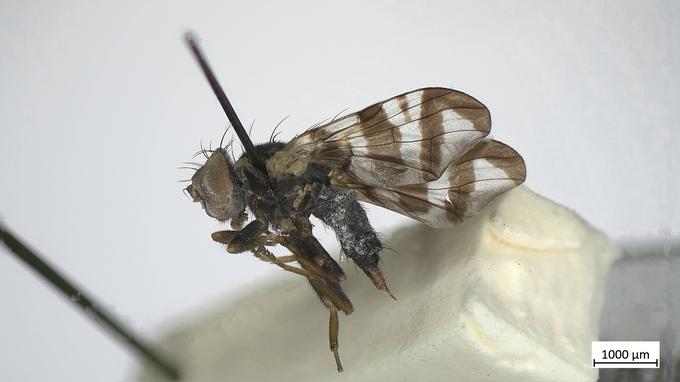
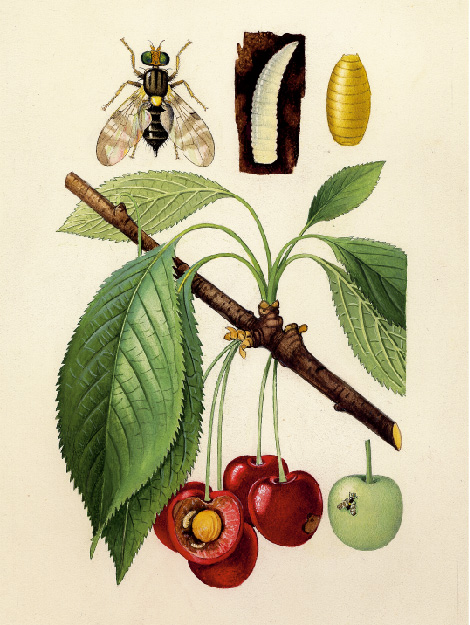
Die erwachsenen Tiere der europäischen Kirschfruchtfliege sind 4 bis 5 mm lang, mit transparenten und von dunklen Bändern durchzogenen Flügeln. Auffällig ist das glänzende hellgelbe Rückenschildchen bei einem ansonsten glänzend schwarzen Körper. Verwechslungsgefahr besteht mit anderen Arten der Gattung Rhagoletis, beispielsweise der Walnussfruchtfliege sowie der Östlichen Amerikanischen Kirschfruchtfliege.
Die kopf- und beinlosen Larven (Maden) sind weiß bis cremefarben und bis zu 6 mm lang.
Biology
From around mid-May (depending on the weather), cherry fruit flies emerge from their pupae, in which they have overwintered in the soil. Before they lay their eggs, the newly hatched flies need a maturation period during which they feed on, amongst other things, the sugary sap of cherry trees and mate.
Eight to ten days after emerging from the pupa, egg-laying begins in sunny, warm weather. The eggs are laid individually beneath the skin of cherries that are just beginning to ripen, and the fruit is then marked with a pheromone to signal to females arriving later that the fruit is already occupied. Each female can lay several hundred eggs during her flight period, which lasts up to two months. Around eight to twelve days later, the larvae (maggots) hatch and burrow deeper into the flesh of the fruit. Near the stone, often in the area around the fruit’s stalk, they then feed for about three to four weeks.
As a result of the fly maggots’ feeding activity inside the cherries, the flesh turns into a soft, rotten mass. Once the cherries have finished ripening, the larvae’s development is also complete, and the fully-grown larvae drop to the ground and pupate at a depth of about 3 cm in the soil. The pupae overwinter in the soil, although mortality during the winter can be very high (> 80 per cent) due to weather conditions. The majority of the surviving pupae emerge the following year as a new generation, whilst up to 3 per cent of the pupae remain in the soil for more than a year.
Symptoms of damage
Infected fruit often show a brownish discolouration on the outside around the stem end. Inside the fruit, infestation can be detected by the soft, rotten flesh around the stone, as well as by the presence of a maggot near the stone. In infested areas, it is not uncommon for up to 80 per cent of the fruit to be affected.
As fruit flies only infest fruit, no damage is caused to other parts of the plant such as leaves, the stem, branches or roots.
Host plants
As the most important domestic animal pest of cultivated cherries(Prunus avium), the European cherry fruit fly attacks medium-late and late cherry varieties from June onward. However, sour cherry(Prunus cerasus) and other Prunus species(e.g. bird and honeysuckle) are also considered host plants.
Prevention and control
- Choice of variety: early-ripening cherry varieties are usually less affected
- Keep secondary hosts at bay: remove or graft over wild cherry trees; do not plant honeysuckle in infested areas
- Delaying emergence – relevant for orchards with medium-maturing varieties: mowing the undergrowth late keeps the soil cool for longer, which can slightly delay the emergence of adults
- Hygiene in the orchard: an early and, above all, complete harvest also removes the majority of larvae from the orchard; even unusable (infested) fruit should be removed from the orchard and destroyed without causing damage to prevent them from burrowing into the soil
- Keeping poultry (chickens) in the orchard – they peck at maggots and pupae from the ground, which can reduce the infestation pressure
- Netting (physical barrier)
- Nets should be installed from the start of the flying season until harvest (required mesh size: 1.3 mm)
- Orchards with low-growing trees – netting can be used to prevent flies from entering newly planted orchards
- Home gardens – it may be sufficient to cover individual branches with nets to enable the harvesting of uninfested fruit from them
- Ground cover around the tree base (physical barrier)
- In standard-tree orchards – netting can prevent adult cherry fruit flies from emerging from the soil
- Installation at the start of the flight period (the edges of the netting are buried; required mesh size 0.8 mm); the flies must remain trapped under the netting until harvest
- A minimum distance of 200 m from other infested cherry trees is required!
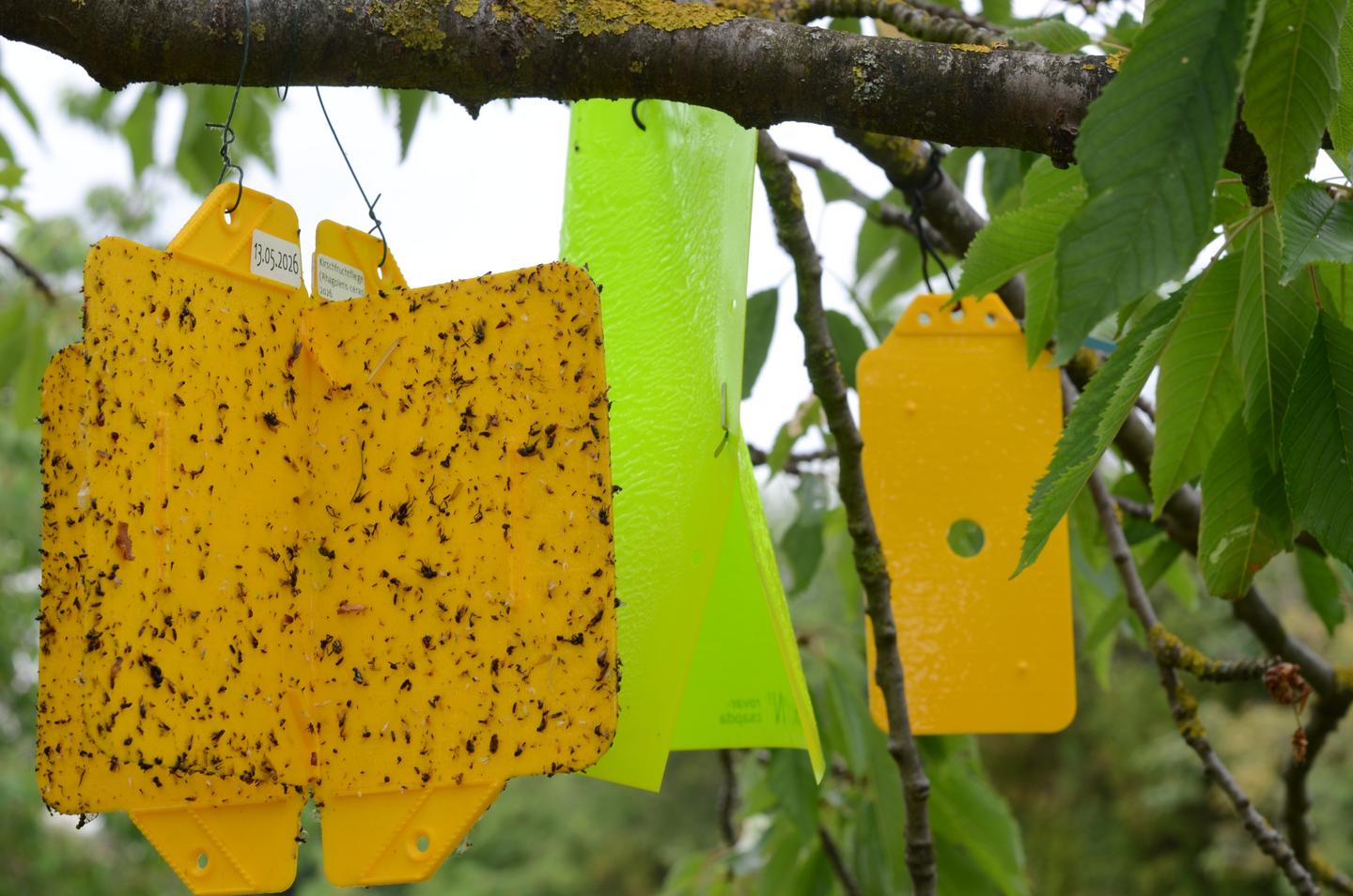
- Yellow sticky traps (e.g. glue boards or similar traps) to catch the adults
- To determine the start of the flight period (using individual traps)
- For monitoring or reducing infestation: depending on the size of the tree, it is recommended to install between two and ten traps at the start of the flight period, on the sun-facing outer edge of the crown (however, to protect beneficial insects, their use is only recommended from the start of the flight period until harvest)
- Pay attention to warning notices – the start of the flight period for adult cherry fruit flies is monitored using traps and announced via warning notices
- Up-to-date catch figures for the cherry fruit fly are also available from the Plant Protection Warning Service
- The optimal time for control is during the flies’ reproductive stage (from hatching to egg-laying)
- Pesticides for controlling the cherry fruit fly are listed in the register of pesticides authorised in Austria.
- In addition, further international control approaches are being investigated, such as the use of specific traps as part of mass trapping schemes, the development of attractants that are as selective as possible, and alternative application methods (e.g. trunk injections of plant protection products).
Last updated: 28.09.2026
automatically translated