American grapevine leafhopper
Scaphoideus titanus
Latest information
Flavescence dorée can cause significant damage to vineyards. In the EU, this disease is therefore listed as a Union quarantine pest and its occurrence must be reported.
Appearance
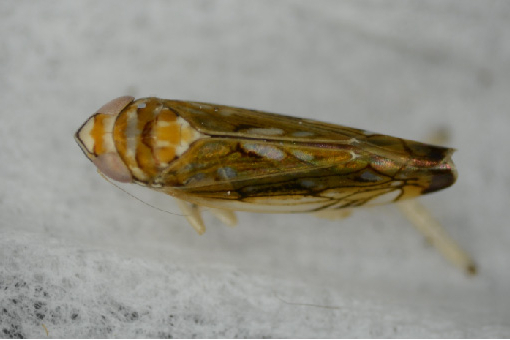
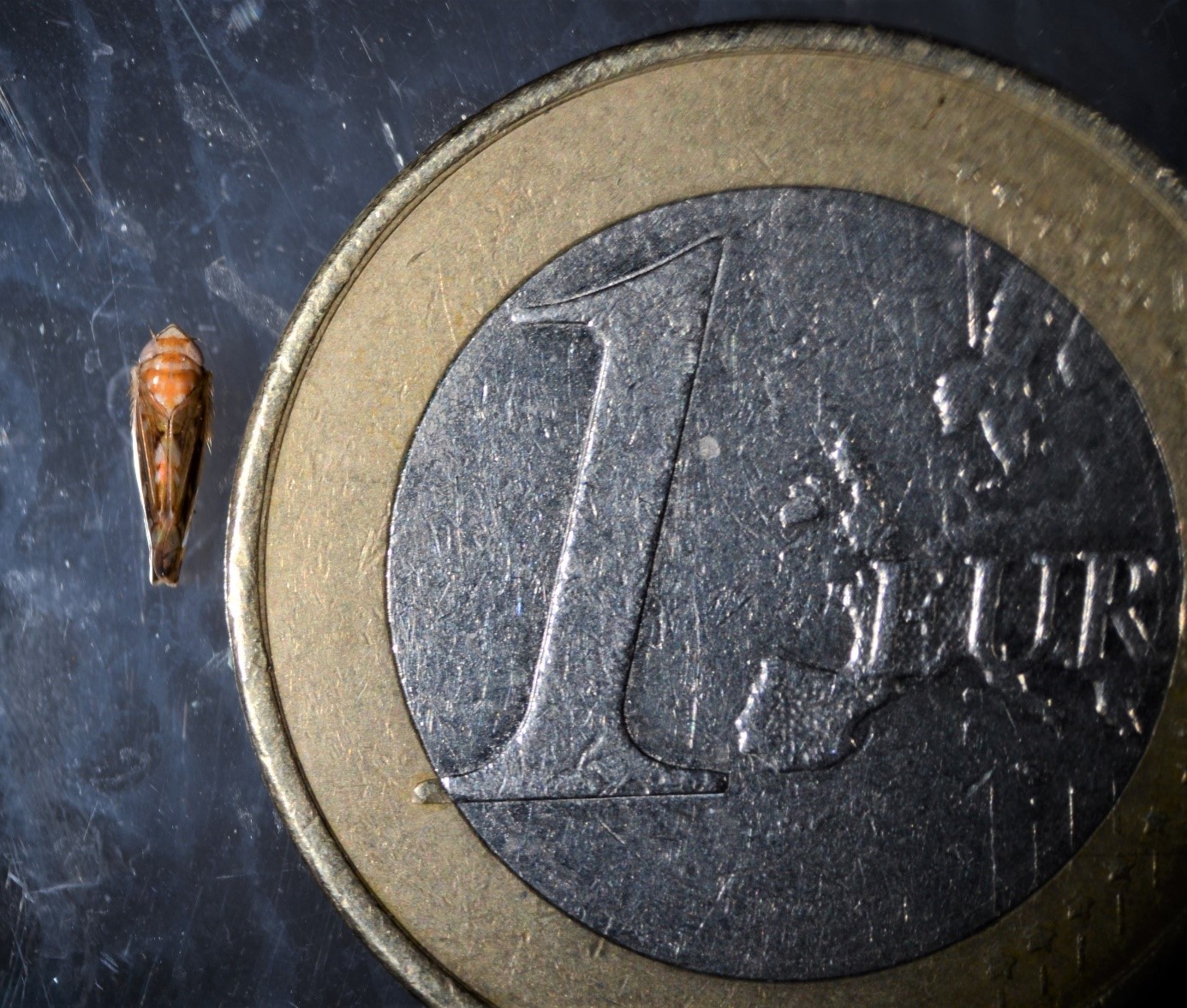
The adult American vine cicada(Scaphoideus titanus) is winged and 5-6 mm long. Its distinctive features are its pointed head shape, medium brown bands on the back and the contrastingly coloured wings, which have white spots and dark wing veins.
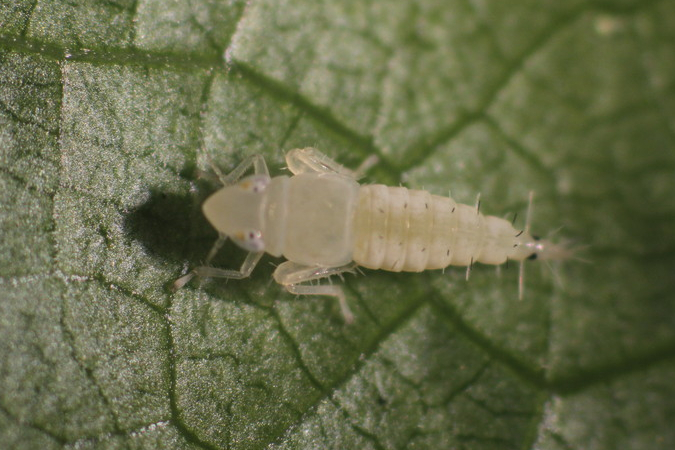
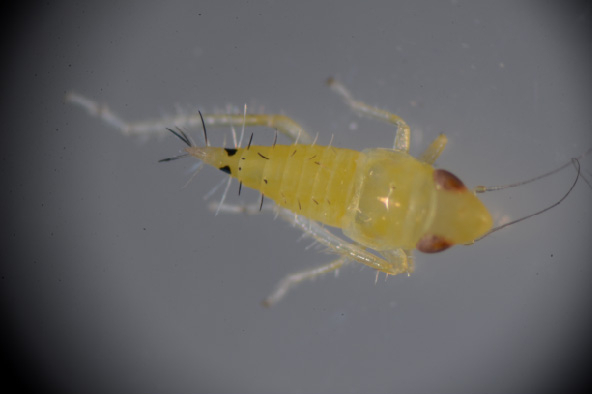
The first larval stage is about 1.5 mm in size and translucent white in colour. There are two dark spots at the end of the body. The other four larval stages also show these two dots. With each moult, the larvae become larger and their body colour darker.
Biology
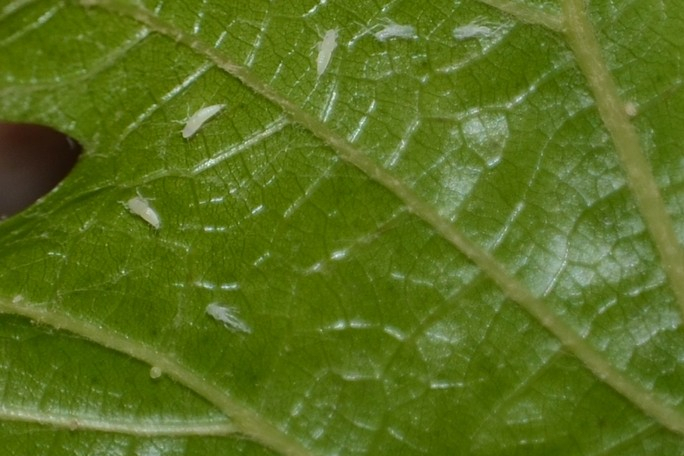
In Austria, the first larvae begin to hatch around the last week of May. Hatching is influenced by the weather, geographical location and altitude of the vineyards and takes several weeks, so that different developmental stages occur simultaneously. The young larvae are often attached to the cane shoots on the underside of the leaves. After a total of five larval stages, the adult, flight-capable cicadas emerge in July. Beginning in late July, the females lay their eggs on the vine under the bark. The American grapevine cicada survives the winter in the egg stage. It goes through one generation a year.
Damage symptoms
In itself, the American grapevine cicada is not a pest. However, it transmits the pathogen of the economically important golden yellowing of the vine (flavescence dorée). These are phytoplasmas that live as cell parasites in the sieve tubes of the vine. Freshly hatched larvae of the American grapevine cicada are always free of flavescence dorée phytoplasmas. If the cicadas suck on a vine infected with flavescence dorée, they ingest the pathogens with the sap flow. After three to four weeks, the cicadas can then pass on the phytoplasmas. The greatest danger with regard to the spread of golden yellowing comes from the adult cicadas. These appear from about mid-July to the end of September. Due to the close attachment of the American grapevine cicada to the vine, the disease can spread rapidly.
Host plants
The main host plant of the American grapevine cicada is the grapevine(Vitis spp), on whose phloem sap the cicadas feed and on which mating and oviposition occur. Occasionally, the American grapevine cicada also feeds on other plants when they grow near vines. For example, it has been found on the following plant species:
- Self-climbing maidenhair vine(Parthenocissus quinquefolia).
- Wicker(Salix viminalis)
- Peach(Prunus persica)
- American elm(Ulmus americana)
However, development from egg to adult cicada is only possible on grapevines.
Distribution
The American vine borer (ARZ) occurs in the following countries in Europe (as of 2025): France, Italy, Spain, Portugal, Switzerland, Slovenia, Croatia, Serbia, Austria, Hungary, Slovakia, Bosnia and Herzegovina, Montenegro, Romania, Bulgaria, Moldova, Czech Republic, Ukraine, Kosovo, Russia and Germany.
In Austria, it was first detected in 2004 in vineyards in south-east Styria. Since then, its distribution, population size and development have been monitored annually in various wine-growing regions, especially in eastern Austria, by AGES experts in close cooperation with the provincial plant protection services and chambers of agriculture, in order to be able to take necessary measures in good time and prevent damage. The American vine borer has now spread extensively in Styria and Burgenland. In Lower Austria and Carinthia, it still occurs in individual regions. In Vienna, isolated ARZs were detected in yielding plants for the first time in 2024.
In 2025, the American grapehopper was monitored at a total of 108 official locations in Lower Austria, Burgenland, Styria, Carinthia and Vienna. The number of American grapevine borer varies in the different wine-growing regions.
In Lower Austria, a further increase in American vine borers was recorded in 2025 at several locations close to the border in the northern and eastern Weinviertel and eastern Carnuntum. Significantly higher population numbers also occurred at several locations in Burgenland. In Styria, on the other hand, the catch figures in the 2025 season were consistently at a very low level. In Vienna, very few ARZ were detected in three yielding plants as late as September or even early October. The molecular genetic analysis of American vine cicadas from Lower Austria for a possible infection with the Flavescence dorée phytoplasma showed that the cicadas were not infected.
As in previous years, the Thermenregion wine-growing region remained free of evidence of the American vine cicada in 2025.
The latest information on the spread and monitoring of the American vine leafhopper can be accessed via the vine protection service or insect-watch.
Economic importance
As an effective vector of flavescence dorée phytoplasma, the American grapevine cicada plays a central role in the epidemiology of flavescence dorée. When flavescence dorée infecting vines and many American grapevine cicadas occur simultaneously, rapid spread of the disease can occur in the viticultural area. Flavescence dorée can cause massive damage to grapevines. The consequences are yield losses, high production costs due to additional inputs or costs for uprooting and replanting. Flavescence dorée has the status of a notifiable Union quarantine disease in the European Union because of its negative impact on viticulture.
Prevention and control
To prevent the larvae from being infected with the flavescence dorée phytoplasma, it is advisable to use suitable plant protection products from the third larval stage onwards(List of plant protection products approved in Austria) .
It should be noted that the larvae hatch over several weeks. A second treatment to capture the later hatched larvae may be necessary. In principle, vector control should always be based on the surveys from monitoring and the recommendations of the relevant state plant protection service and the Chamber of Agriculture. The latest information on American grapevine cicada monitoring can be obtained from the Grapevine Protection Service or insect-watch.
In the fall, close visual inspection of the vines for yellowing symptoms is very important. In case of suspicion, a plant examination is recommended to exclude the possibility of confusion with other causes of yellowing (e.g.: stolbur). Because only if the sources of infection are quickly removed, the spread of golden yellowing of the vine can be prevented.
Specialist information
Publications
EFSA (European Food Safety Authority), Nougadère A, Makowski D, Ferretti L, Costantini E, Gentili A, Rzepecka D, Scala M, Sánchez B, Baldassarre F, Tramontini S and Vos S, 2025. Grapevine flavescence dorée phytoplasma - Pest Report to support the ranking of EU candidate priority pests. EFSA supporting publication 2025: EN-9567. 52 pp. doi. org/10.2903/sp.efsa.2025.EN-9567
Gonella E., Benelli G., Arricau-Bouvery N., Bosco D., Duso C., Dietrich C.H., Galetto L., Rizzoli A., Jović J., Mazzoni V., Mori N., Nieri R., Roversi P., Strauss G., Thiéry D., Trivellone V., Virant-Doberlet M., Lucchi A., Alma A. (2024): Scaphoideus titanus up-to-the-minute: Biology, ecology, and role as a vector. Entomologia Generalis, 44, (3), pp. 481-496.(DOI): doi.org/10.1127/entomologia/2023/2597
Götsch, D., Strauss, G., Blümel, S., 2020. Laboratory trials to reduce egg hatching of the American grapevine leafhopper (Scaphoideus titanus) with selected insecticides; Bulletin of Insectology, 73(1), 53-58. ISSN: 1721-8861 (Print); 2283-0332 (Online).
Strauss, G., Reisenzein, H. (2018). First detection of Flavescence dorée phytoplasma in Phlogotettix cyclops (Hemiptera, Cicadellidae) and considerations on its possible role as vector in Austrian vineyards. Integrated Protection in Viticulture IOBC-WPRS Bulletin, 139, 12-21.
Kopacka, I., Steffek, R., Strauß, G., Reisenzein, H. (2017). Modelling spatial and temporal spread of Flavescence dorée in two Austrian vine growing areas. IOBC-WPRS Bulletin, 128, 66-74.
Strauß, G., Reisenzein, H., Steffek, R., Schwarz, M. (2014). The role of grapevine arbours as overlooked sources of "flavescence dorée" and Scaphoideus titanus in southeastern vineyards of Austria. In: Bertaccini, A. (Ed.), Phytoplasmas and phytoplasma disease management: how to reduce their economic impact. IPWG - International Phytoplasmologist Working Group, 239-245.
Steffek, R., Reisenzein, H., Strauss, G., Leichtfried, T., Hofrichter, J., Kopacka, I., Schwarz, M., Pusterhofer, J., Biedermann, R., Renner, W., Klement, J., Luttenberger, W., Welzl, A.G., Kleissner, A., Alt, R. (2011). VitisCLIM, a project modelling spread and economic impact of Grapevine Flavescence dorée phytoplasma in Austrian viticulture under a climate change scenario. Bulletin of Insectology 64, 191-192.
Last updated: 08.07.2026
automatically translated